Korean counting always follows one frame: Noun + Number + Counter. Skip the counter and the sentence sounds broken to a native speaker, not casual. Say “사과 세 개” (sagwa se gae, “three apples”) and you have a native Korean number paired with the all-purpose counter 개. Say “삼 분” (sam bun, “three minutes”) and you have a Sino-Korean number instead, because minutes always take the Sino-Korean system.
That single distinction, native versus Sino-Korean numbers, trips up more learners than any other part of the Korean counting system. Get the frame and the number choice right, and you can count almost anything you’ll actually need in daily conversation. This guide covers the grammar, the top 10 counters worth memorizing first, the mistakes that give learners away, and short drills with an answer key so you can check yourself before moving on.
- The frame: Noun + Number + Counter, always, no exceptions in standard speech.
- Two number systems: native Korean (하나, 둘, 셋) and Sino-Korean (일, 이, 삼), each tied to specific contexts.
- Contractions: 하나, 둘, 셋, 넷, and 스물 change shape before a counter.
- Where to practice: short drills with an answer key appear later in this guide.
Key Takeaways
Korean counting requires the frame Noun + Number + Counter, with five native numbers changing shape before a counter and number-system choice depending on what you’re counting.
| Point | Details |
|---|---|
| Mandatory frame | Every counted phrase follows Noun + Number + Counter, never number before noun. |
| Master five contractions | 하나, 둘, 셋, 넷, and 스물 become 한, 두, 세, 네, 스무 before any counter. |
| Native vs. Sino rule | Objects, people, age, and hours use native numbers; dates, money, phone numbers, and minutes use Sino-Korean. |
| Top three to memorize | Start with 개 (objects), 명/분 (people), and 마리 (animals); use 개 as a fallback, never for people or animals. |
| Practice consistently | Run the six drills in this guide on a timer, then reinforce them in structured Korean lessons with Com. |
Table of Contents
- Core Rules Every Korean Counters Guide Should Teach First
- When Do You Use Native Korean Numbers vs. Sino-Korean?
- The Top Counters to Memorize First
- Common Mistakes and How to Fix Them
- Practice Drills to Test Yourself
- How to Study Korean Counters Without Burning Out
- Why Ten Counters Beat Fifty
- Turn This Guide Into Real Conversation Practice
- Sources
- FAQ
Core Rules Every Korean Counters Guide Should Teach First
English counts backward from Korean’s perspective: “three apples” puts the number before the noun. Korean puts the noun first, then the number, then the counter. Say “apple three [counter],” not “three apple.” This word order is not optional. A counter sits between the number and the noun it measures in essentially every counted phrase, and reversing that order marks you instantly as a beginner still thinking in English syntax, a pattern worth unlearning early if you’re used to English grammar habits shaping your Korean sentences.
The second rule trips people up even after they’ve internalized word order: five native Korean numbers change shape when they sit directly before a counter. These contracted forms are non-negotiable in fluent speech.
- 하나 (one) becomes 한
- 둘 (two) becomes 두
- 셋 (three) becomes 세
- 넷 (four) becomes 네
- 스물 (twenty) becomes 스무
Numbers five and above keep their dictionary form. Mastering these five pre-counter shapes eliminates one of the most common beginner errors, according to Korean grammar references built around exactly this pattern.
There’s also a written-language wrinkle worth knowing: formal or written Korean sometimes inserts 의 (of) or restructures the phrase for emphasis, but spoken Korean almost always drops it and keeps the counter tight against the number. Here are four worked examples showing the frame and the contractions together:
| Korean | Romanization | Literal gloss |
|---|---|---|
| 학생 두 명이 왔어요 | haksaeng du myeong-i wasseoyo | Student two [counter] came |
| 커피 한 잔 주세요 | keopi han jan juseyo | Coffee one [counter] please give |
| 책 세 권 샀어요 | chaek se gwon sasseoyo | Book three [counter] bought |
| 강아지 네 마리가 있어요 | gangaji ne mari-ga isseoyo | Puppy four [counter] exist |
Notice that every example keeps the noun first, the number and counter glued together right after it, and the contracted number shape (한, 두, 세, 네) doing its job.
When Do You Use Native Korean Numbers vs. Sino-Korean?
Ask yourself one question: am I counting discrete items, or am I stating a label, date, or measurement? That single question resolves most of the confusion around Korean numbers explained as two separate systems rather than one.
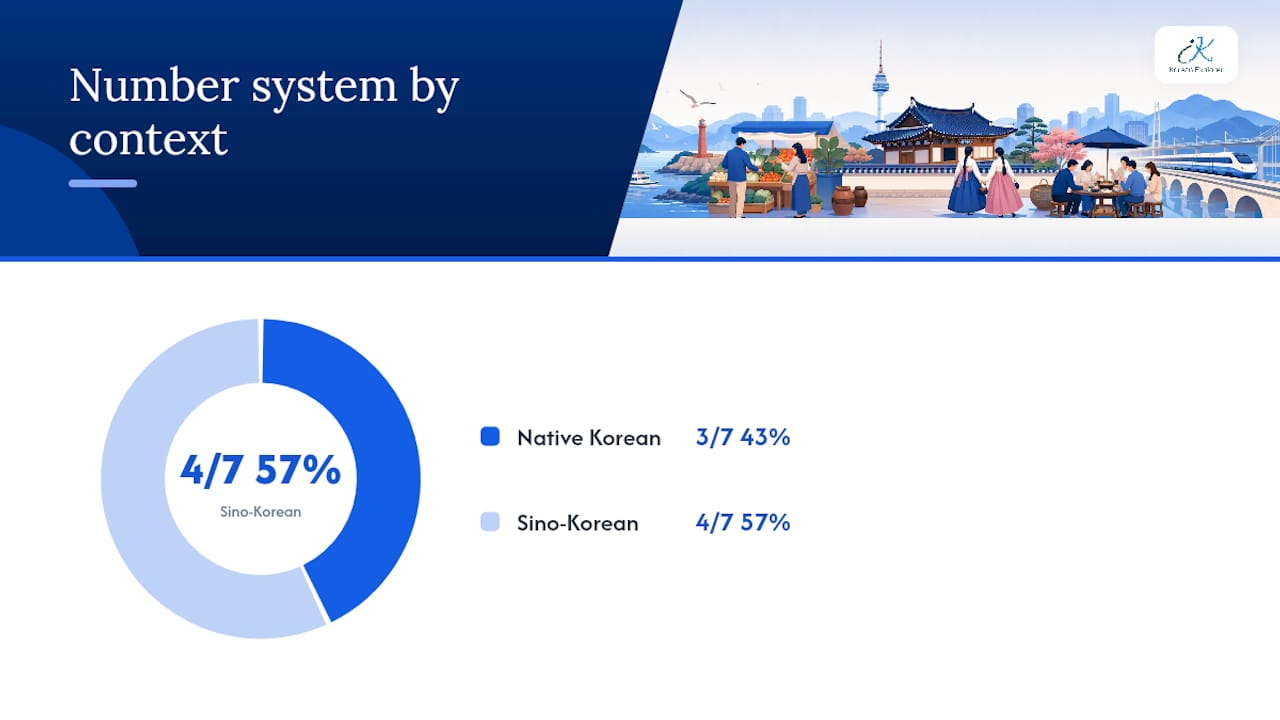
Native Korean numbers (하나, 둘, 셋…) handle physical objects, people, animals, and age. Sino-Korean numbers (일, 이, 삼…), borrowed from Chinese numerals centuries ago, handle dates, money, phone numbers, addresses, measurements, and minutes. Hours are the odd one out: they take native numbers, while the minutes attached to them switch to Sino.
| Context | Number system | Example |
|---|---|---|
| Counting objects/people | Native | 사과 다섯 개 (five apples) |
| Age | Native | 스무 살 (twenty years old) |
| Hours (clock time) | Native | 세 시 (three o’clock) |
| Minutes (clock time) | Sino-Korean | 삼십 분 (thirty minutes) |
| Dates | Sino-Korean | 오월 십일 (May 10th) |
| Money | Sino-Korean | 오천 원 |
| Phone numbers | Sino-Korean | 공일공 (010…) |
Three everyday situations show the split clearly. Telling time mixes both systems in a single sentence: “세 시 삼십 분” (se si samsip bun) means “3:30,” with the hour in native Korean and the minutes in Sino-Korean. Reading a phone number stays entirely in Sino-Korean, digit by digit, and zero is typically read as 공 rather than the standalone word for zero. Stating your age uses native numbers with the contracted form, so a 20-year-old says “스무 살,” not “이십 살,” even though both mean the same number.
There’s also a practical ceiling. Native numbers work comfortably up to 99, and beyond that, Korean speakers typically switch to Sino-Korean even for objects that would otherwise take native numbers at smaller quantities. Labels, codes, and anything resembling an ID number also default to Sino-Korean regardless of size.
The Top Counters to Memorize First
You do not need to learn hundreds of counters to sound competent in Korean. Language instructors consistently point learners toward a compact set of high-frequency counters because a small group covers the overwhelming majority of daily conversation. Here are the ten worth memorizing before anything else.
| Counter | Best used for | Example |
|---|---|---|
| 개 | General objects (fallback) | 사과 두 개 (two apples) |
| 명 | People (neutral/casual) | 친구 세 명 (three friends) |
| 분 | People (polite/formal) | 손님 두 분 (two guests) |
| 마리 | Animals | 고양이 한 마리 (one cat) |
| 잔 | Cups/glasses of drink | 커피 한 잔 (one cup of coffee) |
| 권 | Bound books | 책 세 권 (three books) |
| 장 | Flat sheets (paper, tickets) | 종이 두 장 (two sheets of paper) |
| 대 | Vehicles/machines | 자동차 한 대 (one car) |
| 병 | Bottles | 물 두 병 (two bottles of water) |
| 벌 | Sets of clothing | 옷 한 벌 (one outfit) |
- 개 is your safety net for countable objects when you’re unsure of the exact counter, but never use it for people or animals.
- 명 vs. 분 signals formality: 명 works fine with friends, but switch to 분 when addressing customers, elders, or anyone you’d normally speak to with honorifics.
- 마리 covers animals of any size, from ants to elephants, with no separate counter for large versus small.
- Practicing counters as full chunks, like “커피 한 잔” rather than memorizing “잔” in isolation, is how Korean Explorer instructors and other language educators recommend building recall that actually holds up in conversation.
Common Mistakes and How to Fix Them
Four errors account for most of the awkward-sounding sentences beginners produce. Recognizing them is faster than memorizing more vocabulary.
- Dropping the counter entirely. “사과 세” instead of “사과 세 개” sounds incomplete, because Korean requires a counter between the number and what it’s counting. Fix: never leave a bare number sitting next to a noun in formal contexts (a bare native number after a noun, like 사과 하나, is acceptable only in casual shop talk).
- Wrong word order. “세 사과” puts the number before the noun, mirroring English syntax. Fix: noun always comes first. Say “사과 세 개,” not the reverse.
- Wrong counter class. “사과 세 명” uses the people-counter 명 for apples. Fix: match the counter to the noun category, objects take 개, people take 명 or 분, animals take 마리.
- Mixing number systems with the wrong counter. “삼 개” uses the Sino-Korean 삼 with a counter that expects native numbers. Fix: 개, 명, 마리, and most object/person/animal counters pair with native numbers (한, 두, 세), not Sino ones.
A quick mental check while speaking: if you’re naming a code, date, or measurement, default to Sino-Korean. If you’re pointing at something and counting it with your fingers, default to native Korean with the contracted shape if it’s one through four or twenty.
Practice Drills to Test Yourself
Set a timer for three to five minutes and work through these six items before checking the answer key. Mixing exercise types forces the frame, the number system choice, and the contractions to work together the way they do in real conversation.
- Fill in the counter: 책 두 ___ 있어요 (I have two books).
- Pick native or Sino: telling someone you are twenty-five years old.
- Correct the sentence: 세 친구가 왔어요.
- Fill in the counter: 커피 한 ___ 주세요 (please give me one coffee).
- Pick native or Sino: reading the number 010-1234-5678 aloud.
- Correct the sentence: 고양이 두 명이 있어요.
Answer key:
- 권. Bound books take the counter 권, and the number two contracts from 둘 to 두.
- Native, with contraction. Age uses native numbers, so twenty-five is 스물다섯, not 이십오.
- Correct order: 친구 세 명이 왔어요. The noun 친구 must come before the number and counter.
- 잔. Cups and glasses of drink use 잔, paired with the contracted native number 한.
- Sino-Korean, read digit by digit. Phone numbers never use native numbers, and zero is usually spoken as 공.
- Correct counter: 고양이 두 마리가 있어요. Cats are animals, so they take 마리, not the people-counter 명.
How to Study Korean Counters Without Burning Out
A focused four-week plan beats trying to memorize every counter in one sitting. Here’s a structure that works for adult learners fitting practice around a full schedule.
- Week one: Drill the top 10 counters from this guide using flashcards, one noun-counter chunk per card (not the counter alone).
- Week two: Focus entirely on the five contraction shapes (한, 두, 세, 네, 스무) until they’re automatic, since these appear constantly in casual speech.
- Week three: Practice native versus Sino switching with real scenarios: telling time, reading phone numbers, stating your age and someone else’s.
- Week four: Time yourself producing counted sentences out loud, aiming for under five seconds per sentence, then shift into short role-play dialogues ordering food or shopping.
Spaced-repetition flashcards, shadowing native audio, and recording your own voice to compare pronunciation all reinforce the same muscle memory. Simple verbal exercises built around real dialogue work better than isolated vocabulary lists, because counters rarely appear alone in actual speech.
Pro Tip: Learn counters as noun chunks from day one, “커피 한 잔” instead of just “잔,” and you’ll retrieve the right counter automatically in conversation instead of translating word by word.
Track progress by testing yourself weekly with the same six-item format used in the drills above. Once you can produce a counted sentence correctly without pausing to think through the rule, you’re ready to move from deliberate practice into free conversation.
Why Ten Counters Beat Fifty
Korean has dozens of specialized counters, some used only for very specific objects like sheets of paper in a particular thickness, or thin flat objects versus thick ones. Chasing all of them early is a waste of study time for anyone trying to hold a real conversation.
The top 10 counters in this guide cover the overwhelming majority of what comes up when you order food, talk about your family, describe your commute, or shop for anything. Every hour spent memorizing an obscure counter for counting stacks of dried squid is an hour not spent making the top 10 automatic, and automaticity, not breadth, is what makes you sound fluent rather than hesitant.
Error tolerance matters more than perfection while you’re building this. If you say 명 when you should have said 분, a native speaker understands you instantly and probably won’t correct you. Getting the frame right (Noun + Number + Counter) and the number system right (native or Sino) matters far more than nailing every specialized counter on the first try. Keep a small notebook of counters you hear in shows, conversations, or ordering food, and add them only once the top 10 feel automatic. Formality is worth extra attention here too: 명 works with friends, but 분 shows respect toward customers, elders, or anyone you’d address with honorifics, and mixing that up in a service setting reads as more than a grammar slip.
Turn This Guide Into Real Conversation Practice
Reading about counters gets you the rules. Using them correctly under pressure, mid-conversation, with a native speaker waiting for your answer, takes structured feedback that a guide alone can’t give you. Com’s Korean Explorer courses build exactly that kind of practice into every lesson, whether you’re learning for travel, friendships, or work.
Classes run both online over Zoom and in person at our center above Tanjong Pagar MRT, with instructors who catch the exact mistakes covered in this guide (wrong word order, mismatched counters, dropped contractions) in real time instead of leaving you to self-correct from a book. You get structured drills built around the same high-frequency counters and number systems covered here, native-instructor feedback on your pronunciation and sentence order, real conversation practice instead of isolated vocabulary lists, and progress tracking so you know when you’re ready to move past the basics. If you want the grammar in this guide to turn into confident, spontaneous speech, browse our Korean language courses and find a class schedule that fits your week.
Sources
For learners who want to go deeper into the grammar or need more practice material, these resources build directly on what’s covered here.
- Elon
- The choice between Native and Sino-Korean number systems | Migaku
- Counting in Korean – When To Use Sino-Korean and Native Numbers in Daily Life | The Korean Learner
FAQ
What Is the Basic Rule for Korean Counters?
Every counted phrase follows Noun + Number + Counter, with the counter word appearing directly after the number and matching the category of noun being counted.
When Do I Use Native Korean Numbers Instead of Sino-Korean?
Use native Korean numbers for physical objects, people, animals, age, and hours; use Sino-Korean numbers for dates, money, phone numbers, addresses, measurements, and minutes.
Which Korean Counters Should I Learn First?
Start with 개 (objects), 명 or 분 (people), and 마리 (animals); these three, along with 잔, 권, and 장, cover most everyday conversation.
Why Do Numbers Like 하나 and 둘 Change Shape?
Five native numbers, 하나, 둘, 셋, 넷, and 스물, contract to 한, 두, 세, 네, and 스무 whenever they sit directly before a counter, and this shift is required in fluent speech.

How Can I Practice Korean Counters More Effectively?
Practice counters as full noun-counter chunks rather than isolated words, drill the native versus Sino distinction with real scenarios like time and phone numbers, and get feedback through structured classes such as those offered by Korean Explorer.