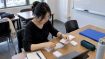
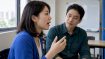
For most adult learners in Singapore, the fastest route to conversational Korean is a small-group, instructor-led course with a placement test and a free trial class. Whether you choose an in-person evening session or a live Zoom class, that format gives you real-time feedback, a structured curriculum, and a schedule you can actually keep.
Start here:
- Take a placement test before enrolling (even if you think you’re a complete beginner)
- Book a free trial class to check the teaching style and class pace
- Confirm the class size is small (under 15 students is a reliable benchmark)
- Check that lessons are recorded so you can review what you missed
Pro Tip: Don’t skip the placement test. Many adults who studied a little Korean on their own end up placed in the wrong level and repeat material they already know. A 10-minute placement check saves weeks.
Native Korean instructors with bilingual English support, recorded lesson access, and a clear level-by-level path are the three features worth prioritizing above everything else.
Key Takeaways
A small-group, instructor-led Korean course with a placement test and recorded lesson access is the most reliable format for adult learners in Singapore to reach conversational proficiency within one year.
| Point | Details |
|---|---|
| Take a placement test first | Skipping it risks repeating material you know or landing in a class too advanced to follow. |
| Small-group live classes win | Real-time instructor feedback in small groups produces faster spoken fluency than self-paced video alone. |
| Budget one year for conversational level | Most adults reach functional intermediate Korean after 3–4 semesters of weekly structured classes. |
| Confirm recordings and refund terms | Ask before paying: recorded lesson access and a clear cancellation policy are non-negotiable. |
| Korean Explorer is a local option | Structured level-by-level courses, native instructors, small classes, and in-person or Zoom formats in Singapore. |
Table of Contents
- Which Korean course level is right for you?
- What class formats and schedules work for working adults?
- What does a practical adult Korean course actually teach?
- How to choose the right Korean course in Singapore
- How much does a Korean course cost, and how long will it take?
- Why small-group, instructor-led classes work best for adults
- How to enroll: a step-by-step process
- What adult learners actually need in the classroom
- Korean Explorer: structured adult courses in Singapore
- Sources
- FAQ
Which Korean course level is right for you?
Picking the wrong level is the single most common mistake adult learners make. Starting too low wastes your first term. Starting too high kills motivation fast.
Most structured adult Korean programs run three broad tiers:
- Korean Fundamentals (Hangul and pronunciation): You learn to read and write the Korean alphabet, Hangul, and nail the basic sound system. This stage takes roughly two to four weeks in a focused class. If you can already read Hangul at a basic speed, skip this level entirely.
- Beginner 1 through 6: The bulk of early learning happens here. You build everyday vocabulary, core grammar patterns, and the ability to introduce yourself, make plans, ask for directions, and handle simple social situations. Each sub-level typically covers one term.
- Intermediate levels: You move into extended conversation, functional business language, and more complex grammar. A milestone many learners notice at this stage: mastering both Korean number systems (Sino-Korean for dates and money, native Korean for age and counting objects) is what separates a confident beginner from a functional intermediate speaker.
How to self-check your level before enrolling:
- Can you read Hangul without sounding out each letter slowly? If no, start at Fundamentals.
- Can you introduce yourself and state your job, age, and nationality in Korean? If no, start at Beginner 1.
- Can you make simple plans (“Let’s meet at 3 PM on Friday”) and understand a basic reply? If yes, you’re likely Beginner 3 or above.
- Can you discuss your work, express opinions, and follow a short conversation? That’s Intermediate territory.
Course providers that publish level-by-level learning outcomes from Fundamentals through Intermediate make it far easier to self-locate accurately. Still, a placement test beats self-assessment every time. Many adults incorrectly identify as absolute beginners and end up repeating Hangul-only classes they don’t need.
Pro Tip: If you’ve watched Korean dramas or listened to K-pop for years, you likely have passive vocabulary that puts you above Beginner 1. Tell the placement tester this — it matters.
What class formats and schedules work for working adults?
The format question comes down to one thing: what fits your week without requiring heroic discipline?
In-person evening group classes are the most popular format for working adults in Singapore. Sessions typically run on weekday evenings, two hours per session, once a week. University-affiliated evening programs commonly use 10-week terms with sessions starting around 6:30 PM, which maps well onto a standard office schedule. You get a physical classroom, face-to-face conversation practice, and the accountability of showing up somewhere.
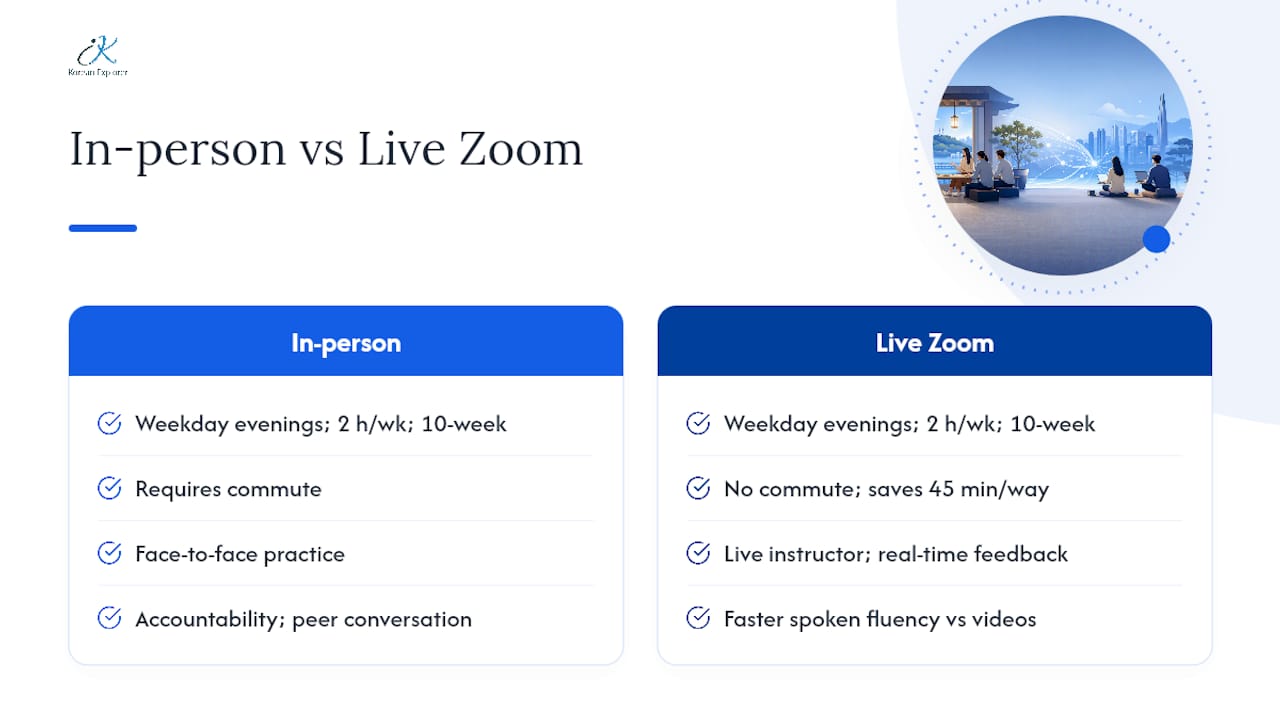
Live Zoom group classes follow the same structure but remove the commute. For adults in Jurong or the east side of Singapore, an online class can save 45 minutes of travel each way. The key word is live: a live Zoom class with a native instructor and real-time feedback is a fundamentally different experience from a pre-recorded video course. Educators consistently report that small live Zoom classes with real-time instructor feedback produce faster spoken fluency gains than self-paced video alone.
Private 1:1 lessons cost more but compress the timeline. If you have a specific business trip, job interview, or professional goal with a deadline, a private lesson schedule lets you focus exactly where you need to. The tradeoff is that you lose peer conversation practice, which is harder to replicate outside a group setting.
Corporate training is structured for teams, usually delivered on-site or via Zoom, with curriculum tailored to the company’s industry and communication needs.
Typical adult schedule in Singapore:
10-week terms with one 2-hour session per week is the standard model used by adult programs, including community-based programs. Some providers also offer intensive 4-week formats for faster gains.
For online classes, you need a device with a working webcam and microphone, a stable internet connection (2 Mbps or faster), and Zoom installed. Most providers give you access to recorded lessons so you can re-watch anything you missed or didn’t fully catch the first time.
You can compare group vs. private class formats in more detail to decide which suits your learning style and schedule.
What does a practical adult Korean course actually teach?
A well-designed adult course covers four skills: speaking, listening, reading, and writing. In practice, speaking and listening get the most class time because that’s where adults need the most live practice.
By level, here’s what the curriculum typically covers:
- Fundamentals: Hangul reading and writing, basic pronunciation rules, and the sound distinctions that trip up English speakers (aspirated vs. unaspirated consonants, vowel length)
- Beginner: Everyday grammar patterns (sentence structure, verb conjugation, politeness levels), core vocabulary for daily life, and conversational scripts for common situations
- Intermediate: Extended conversation, functional business language, reading short texts, and navigating real-world Korean communication
What happens inside a class session:
Pair dialogues and role-plays are the engine of most good adult classes. You practice a grammar point, then immediately use it in a scripted conversation with a classmate, then in a freer exchange. Pronunciation drills happen early in each term and resurface whenever the instructor hears a pattern of errors. Error correction is direct and immediate, which is exactly what you don’t get from a self-paced app or video.

Support materials typically include lesson notes, vocabulary lists, and access to recorded sessions. Some programs also offer supplementary resources or structured self-study paths. Subscription-based lesson systems with ordered curricula can work well as a supplement between classes, giving you a clear sequence to follow on your own time.
MOOCs and university-taught online beginner courses, like the Korean for Beginners course on Coursera, offer a structured module path and are useful as a starting point or supplement. They’re not a substitute for live speaking practice, though. Reading and grammar you can learn alone. Spoken fluency requires another person in the room (or on the screen).
How to choose the right Korean course in Singapore
Before you pay for anything, run through this checklist:
Decision checklist:
- Does the provider offer a placement test?
- Is there a free trial or preview class?
- Is the class size small (ideally under 15 students)?
- Are instructors native Korean speakers with bilingual English support?
- Is there a clear level path from Fundamentals through Intermediate?
- Are lessons recorded for later review?
- Are course materials included or clearly listed?
Questions to ask before enrolling:
- What is your class size limit?
- Can I access recordings if I miss a session?
- What is your makeup class or catch-up policy?
- What are your instructors’ teaching qualifications?
- What is your refund or cancellation policy if I need to drop the course?
Red flags to watch for:
- No placement test offered (you’re expected to self-select your level)
- Class sizes above 20 students with no mention of small-group interaction
- No trial class or preview option
- Vague curriculum with no level descriptions
- No refund policy or unclear cancellation terms
Online vs. in-person for your goals:
If your goal is conversational Korean for social use, both formats work equally well. If you’re targeting business Korean or professional communication, in-person classes give you slightly more natural interaction practice. That said, a well-run live Zoom class with a small group and an active instructor closes most of that gap.
How much does a Korean course cost, and how long will it take?
Typical cost ranges in Singapore:
- Group classes: roughly SGD 200–400 per 10-week term, depending on the provider and session length
- Private 1:1 lessons: typically SGD 60–120 per hour, depending on instructor experience and lesson format
- Corporate training: priced per session or per program, usually quoted on request
- Intensive short programs: cost varies; expect a higher per-week rate than a standard term
These are general market ranges. Always confirm what’s included: course materials, recorded lesson access, and any administrative fees.
Realistic timelines:
Adult learners who attend a structured class once a week and do light review between sessions typically need 3–4 semesters (roughly one year) to reach a functional intermediate conversational level, according to data from adult Korean language programs. That’s the equivalent of being able to hold a real conversation, navigate everyday situations, and handle basic professional exchanges.
- Basic conversation (greetings, introductions, simple plans): 1 semester (10 weeks)
- Functional everyday Korean: 2–3 semesters
- Business conversational level: 4+ semesters, faster with private lessons or intensive formats
What adds cost: private lessons, intensive programs, and corporate training all carry a premium over standard group classes. What’s often included in group programs: lesson notes, vocabulary materials, and recorded session access.
Before you pay, confirm in writing:
- The refund policy if you need to withdraw before the term ends
- The cancellation policy if a class is cancelled by the provider
- Whether you can transfer to a different term or format
Why small-group, instructor-led classes work best for adults
The research on this is consistent. Educators at established adult Korean programs report that small live classes with real-time instructor feedback produce faster progress for adult spoken fluency than self-paced video learning alone. The mechanism is straightforward: adults need immediate error correction to break bad pronunciation and grammar habits before they solidify.
Common adult learning barriers and how structured classes address them:
- Motivation drop-off: A fixed weekly schedule with a live class creates external accountability that self-study can’t replicate.
- Error fossilization: Without correction, adults repeat the same mistakes until they become habits. An instructor catches these early.
- Scheduling: Evening and weekend class options let adults fit language study around work without sacrificing sleep.
What good instructors actually do in class:
Role-play and mixed-skill pair activities are the most effective classroom tools for adult learners. Pronunciation drills at the start of each term catch problems early. Targeted correction during conversation practice, rather than interrupting every sentence, keeps fluency building while still fixing errors.
Structured lesson sequences and placement tests also reduce wasted time by ensuring you’re practicing material just beyond your current ability, not repeating what you already know. That’s the zone where retention is highest.
Pro Tip: The best ways to learn Korean always combine live speaking practice with structured review. Ten to twenty minutes of daily self-study between weekly classes compounds faster than you’d expect.
How to enroll: a step-by-step process
- Self-check your level using the questions in the course levels section above. Write down what you can and can’t do in Korean.
- Take a placement test with your chosen provider. Bring your honest self-assessment notes. If you’ve studied before, mention it.
- Book a free trial or orientation class at the level the placement test recommends. Pay attention to class size, instructor style, and how much speaking time you actually get.
- Confirm your schedule and payment terms. Check the start date, session times, refund policy, and whether recordings are included.
- Prepare your tech and materials. For online classes: test your webcam, microphone, and internet connection before the first session. Download Zoom and log in at least 10 minutes early. For in-person classes: bring a notebook and any pre-reading materials the provider sends.
What to bring to a placement test or trial class:
- A brief note of what Korean you already know (apps used, previous classes, travel experience)
- Any questions about the curriculum, class size, or makeup policy
- An open mind about your level — trust the placement result over your own estimate
For busy adults: Ask upfront whether the provider offers makeup classes, alternative session slots, or recorded access if you miss a session. Most good providers have a policy. If they don’t, that’s worth knowing before you commit.
What adult learners actually need in the classroom
Adults learn differently from children. They come in with stronger analytical skills, clearer goals, and less time. They also come in with more self-consciousness about making mistakes in front of others.
The most effective habit I’ve seen in adult learners is simple: speak first, read later. Adults instinctively want to understand the grammar rule before they try using it. That’s backwards for language acquisition. The learners who progress fastest are the ones who attempt the sentence, get corrected, and try again, rather than waiting until they feel ready.
A daily practice window of 10–20 minutes between weekly classes makes a measurable difference. It doesn’t need to be formal study. Reviewing the week’s vocabulary while commuting, or repeating a dialogue from the recorded lesson, keeps the material active in memory.
If you’re worried about starting because you feel too old or too busy, set that aside. Adult learners bring focus and motivation that younger students often don’t. The structure of a good class is designed for exactly your situation.
Korean Explorer: structured adult courses in Singapore
Korean Explorer is a leading Korean language school in Singapore built specifically for adult learners. The curriculum follows a structured, level-by-level path developed in alignment with Seoul National University standards, taught by native Korean instructors who are fluent in both Korean and English.
Class sizes are kept small to give you real speaking time and direct instructor feedback every session. You get access to recorded lessons so a missed class doesn’t mean lost progress. Formats include in-person evening group classes, live Zoom group sessions, private 1:1 lessons, and corporate training programs for teams.
Korean Explorer is located at 10 Anson Road, Level 22, International Plaza, Singapore 079903, right above Tanjong Pagar MRT. Additional centers in Jurong and Tampines serve learners across the island.
The next step is straightforward: browse the full course catalog to find your level and format, or go directly to the adult Korean course enrollment page to book a placement test or trial class.
Sources
- SNU LEI Language Education Institute, Seoul National University
- Talk To Me In Korean Courses
- A Bridge to the World: Korean Language for Beginners Ⅰ | Coursera
FAQ
Which Korean course is best for adults in Singapore?
A small-group, instructor-led course with a placement test, native Korean instructor, and recorded lesson access is the most effective format for most adult learners. Korean Explorer offers this structure in both in-person evening and live Zoom formats in Singapore.
How much does it cost to learn Korean in Singapore?
Group Korean classes in Singapore typically run SGD 200–400 per 10-week term. Private lessons generally cost SGD 60–120 per hour, depending on the instructor and format.
Can I learn Korean on my own without a class?
Self-study tools and structured online resources can build reading and grammar knowledge, but reaching conversational fluency requires live speaking practice with real-time feedback, which self-paced apps and videos cannot replicate on their own.
Where is the best place to learn Korean in Singapore?
Korean Explorer, located at 10 Anson Road, Level 22, International Plaza (above Tanjong Pagar MRT), is a structured option with native instructors, small class sizes, and both in-person and online formats. Additional centers are available in Jurong and Tampines.
How long does it take to reach conversational Korean?
Most adult learners attending weekly structured classes reach a functional intermediate conversational level after 3–4 semesters, roughly one year, based on data from adult Korean language programs.