Korean sentence order follows a Subject–Object–Verb pattern, meaning the verb always comes last. Take this example: 저는 커피를 마셔요 (jeoneun keopireul masyeoyo), which translates literally as “I coffee drink.” That single sentence captures the whole system.
A few things to know right away:
- The verb or predicate closes every clause, without exception. Other elements can shift around it, but the verb stays put.
- Particles like 은/는, 이/가, and 을/를 label each word’s grammatical role, so the sentence still makes sense even when the order changes.
- Modifiers always come before what they modify. Adjectives precede nouns; relative clauses precede nouns; adverbs precede verbs.
- Subject omission is common in conversation. Context and particles do the work of identifying who is doing what.
The Oxford Research Encyclopedia of Linguistics confirms Korean is strongly head-final: dependents precede their heads, and the predicate remains final. Korean Explorer, whose curriculum draws on materials developed with Seoul National University, builds its beginner courses around exactly these structural foundations.
Key Takeaways
Korean sentence order is head-final and verb-last: the predicate closes every clause, particles mark grammatical roles, and modifiers always precede the words they modify.
| Point | Details |
|---|---|
| Verb always comes last | The predicate closes every Korean clause; this rule never changes regardless of other reordering. |
| Particles mark roles | 은/는, 이/가, 을/를, 에, 에서, and 에게 identify function so word order can shift without losing meaning. |
| Modifiers precede heads | Adjectives, relative clauses, and adverbs all come before the noun or verb they modify. |
| Neutral adverbial order | Time + Place + Subject + Indirect Object + Direct Object + Manner + Verb is the default scene-setting sequence. |
| Subject omission is normal | Korean speakers regularly drop the subject in conversation when context makes it clear. |
Table of Contents
- Why does Korean sentence order look backwards to English speakers?
- Core sentence templates you can use right now
- What particles do and why they matter
- Where to place time, place, and manner words
- Common word-order variations you will actually encounter
- Graded examples from beginner to advanced
- How to practice Korean sentence structure every day
- How conjunctions change sentence order in complex sentences
- How auxiliary verbs and verb endings shape meaning
- Sentence-final particles that go beyond politeness
- What actually matters most when learning Korean sentence structure
- Sources
- FAQ
Why does Korean sentence order look backwards to English speakers?
English is Subject–Verb–Object. Korean is Subject–Object–Verb. That one swap puts the verb at the end instead of the middle, and it changes how you process every sentence you hear or read.
Here is the same idea in both languages, side by side:
| English (SVO) | Korean (SOV) | Literal gloss |
|---|---|---|
| I drink coffee. | 저는 커피를 마셔요. | I coffee drink. |
| She reads books. | 그녀는 책을 읽어요. | She books reads. |
| He eats rice. | 그는 밥을 먹어요. | He rice eats. |
The reversal is not random. Korean is what linguists call a head-final language: the head of any phrase, whether a noun phrase, verb phrase, or clause, comes after its dependents. Adjectives come before nouns. Relative clauses come before nouns. The verb comes after its objects. Every layer of the grammar follows the same rule, which is actually a useful regularity once you internalize it.
The practical consequence for listening: you cannot fully understand a Korean sentence until the last word arrives. English speakers instinctively try to parse meaning as soon as they hear the verb, but in Korean that verb is still coming. The fix is to hold pre-verbal material in working memory while expecting the predicate at the end. It feels awkward at first, but it becomes automatic with practice. When reading a long sentence, scan left to right, collect the modifiers and objects, and wait for the verb to resolve everything.
One rule is absolute: the predicate must come at the end of the clause. While other elements can move for emphasis or topic-setting, the verb never migrates to the middle or the front. That single constraint is the most important structural fact in Korean grammar.
Core sentence templates you can use right now
Korean sentence structure in its simplest form gives you four reliable skeletons. Master these and you can produce grammatically correct sentences from day one.
| Template | Hangul example | Romanization | Literal translation |
|---|---|---|---|
| Subject + Verb | 저는 가요. | jeoneun gayo | I go. |
| Subject + Object + Verb | 저는 물을 마셔요. | jeoneun mureul masyeoyo | I water drink. |
| Topic + Comment | 한국어는 재미있어요. | hangugeo-neun jaemiisseoyo | Korean (topic) interesting is. |
| Subject + Indirect Object + Direct Object + Verb | 저는 친구에게 선물을 줘요. | jeoneun chingue-ge seonmureul jwoyo | I friend-to gift give. |
These core beginner patterns cover the vast majority of everyday sentences. The copula structure (noun + 이에요/예요, meaning “is”) handles “X is Y” sentences: 저는 학생이에요 (jeoneun haksaengieyo) means “I am a student.”
Politeness endings attach directly to the verb stem and determine the register of the whole sentence. The three you will use most often:
- 습니다/ㅂ니다 (seumnida/mnida): formal polite, used in presentations, news, and formal settings.
- 어요/아요 (eoyo/ayo): standard polite, the everyday default for most adult conversations.
- 아/어 (a/eo): informal, used only with close friends or people younger than you.
The verb 먹다 (to eat) becomes 먹습니다 (formal), 먹어요 (standard polite), or 먹어 (informal). The stem stays the same; only the ending changes.
What particles do and why they matter
Particles are the engine of Korean grammar. They attach to nouns and tell you what role each word plays in the sentence, which is exactly why word order can be flexible without causing confusion.
Topic vs. subject markers:
- 은/는 (eun/neun): marks the topic of the sentence, often carrying a contrast or “as for X” nuance. Use 은 after a consonant, 는 after a vowel.
- 이/가 (i/ga): marks the grammatical subject, often introducing new information or emphasizing who specifically did something. Use 이 after a consonant, 가 after a vowel.
The difference matters. 저는 학생이에요 (I am a student) sets “I” as the topic of the conversation. 제가 했어요 (I did it) emphasizes that it was specifically me, not someone else. Beginners often use 은/는 for everything, but that flattens the nuance and can sound unnatural in contexts where 이/가 is expected.
Object marker:
- 을/를 (eul/reul): marks the direct object. 을 follows a consonant; 를 follows a vowel. Without this particle, a listener has to guess whether a noun is the subject, object, or something else.
Location and time particles:
- 에 (e): marks a destination or a point in time. 학교에 가요 (I go to school); 세 시에 만나요 (Let’s meet at 3 o’clock).
- 에서 (eseo): marks the location where an action takes place. 학교에서 공부해요 (I study at school). The distinction between 에 and 에서 trips up many learners: 에 is where you are going or a static location for existence; 에서 is where an action happens.
- 에게/한테 (ege/hante): marks the recipient of an action. 친구에게 전화해요 (I call my friend). 한테 is more colloquial; 에게 is more formal.
Particle stacking happens when a noun carries both a case particle and an additional marker. The case particle comes first, then the additional one. For example, 학교에서는 (at school, as for) stacks 에서 (location) and 는 (topic/contrast). You will see this in sentences that contrast two locations: 집에서는 공부하지만 학교에서는 놀아요 (At home I study, but at school I play).
In spoken Korean, particles are frequently dropped, especially 을/를 and 이/가. Context and word order carry the meaning instead. This is fine in casual speech, but in writing or formal situations, keeping particles in place avoids ambiguity.
Where to place time, place, and manner words
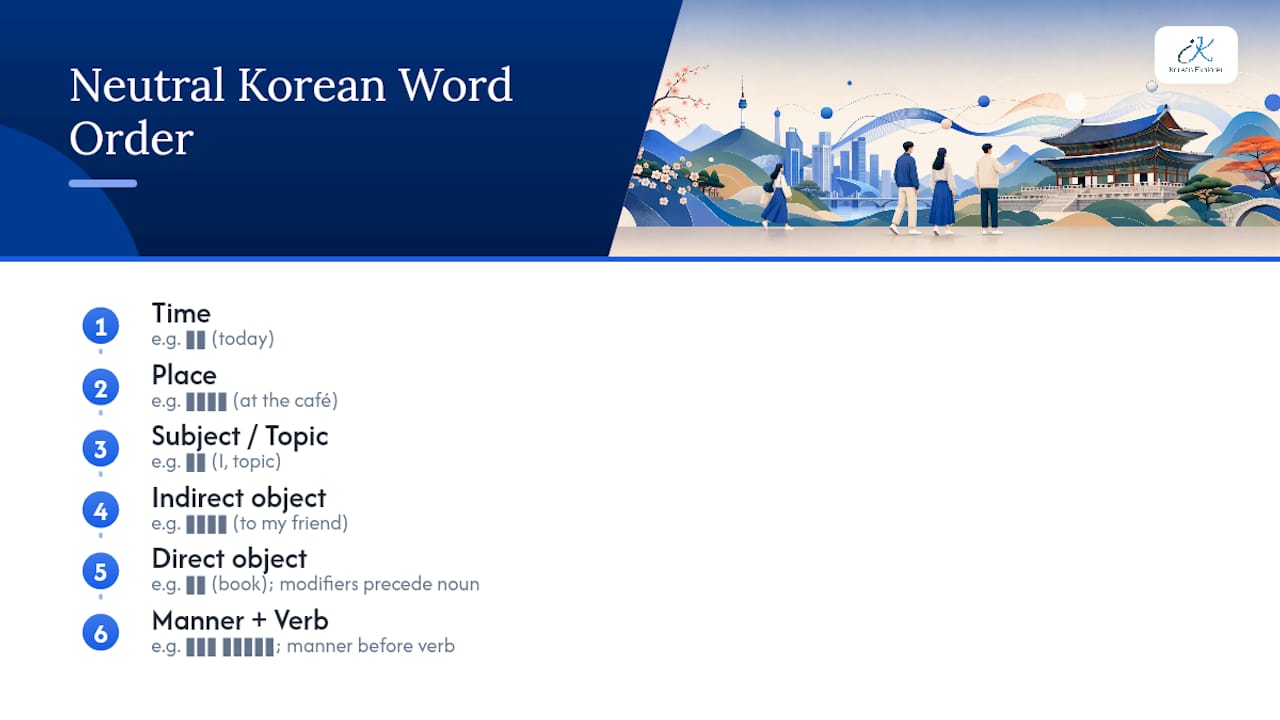
The neutral ordering for a full Korean sentence, when you include scene-setting elements, runs roughly: [Time] + [Place] + [Subject/Topic] + [Indirect Object] + [Direct Object] + [Manner] + [Verb].
Practice Korean’s grammar documentation frames this as a practical teaching template, with particles marking function even when the order shifts. Here is what it looks like in a real sentence:
오늘 카페에서 저는 친구에게 책을 천천히 읽어줬어요.
(oneul kapeseo jeoneun chingue-ge chaekeul cheoncheonhi ilgeojwosseoyo)
“Today at the café, I slowly read a book to my friend.”
Breaking it down: 오늘 (today, time) + 카페에서 (at the café, place) + 저는 (I, topic) + 친구에게 (to my friend, indirect object) + 책을 (book, direct object) + 천천히 (slowly, manner) + 읽어줬어요 (read for, verb).
Adjectives and relative clauses always come before the noun they modify. In English you can say “the book that I read yesterday” and the relative clause follows the noun. In Korean, the relative clause precedes it: 어제 내가 읽은 책 (eonje naega ilgeun chaek), literally “yesterday I read book.” The modifier wraps around the noun from the left.
Manner adverbs typically sit directly before the verb. 빨리 가요 (ppalli gayo, “go quickly”) and 열심히 공부해요 (yeolsimhi gongbuhaeyo, “study hard”) both follow this pattern.
Pro Tip: When you encounter a long Korean sentence with multiple modifiers, read left to right and collect everything until you hit a noun or a verb. Each cluster of modifiers belongs to the nearest head on its right. Once you spot the verb at the end, the whole sentence snaps into place.
Common word-order variations you will actually encounter
Korean word order is more flexible than English, but that flexibility has clear limits and specific purposes.
Topicalization moves an element to the front of the sentence and marks it with 은/는 to signal “as for X.” This is not random scrambling; it signals that the speaker is setting up a contrast or shifting the conversational focus.
- Neutral: 저는 사과를 좋아해요. (I like apples.)
- Topicalized: 사과는 저도 좋아해요. (As for apples, I like them too.)
OSV order for emphasis fronts the object without a topic marker, placing it in a position of prominence. 커피를 저는 마셔요 is grammatical and means roughly “Coffee is what I drink” with a slight emphasis on coffee. It sounds marked, not neutral.
A few key points about variation:
- The predicate never moves. Scrambling applies only to pre-verbal elements.
- Particles are what make scrambling interpretable. Without them, a reordered sentence becomes ambiguous.
- Fronting an element without 은/는 creates emphasis; fronting with 은/는 creates topic or contrast.
Subject omission is one of the most common features of spoken Korean. Because particles identify roles, and because context usually makes the subject obvious, Koreans drop subjects constantly. 밥 먹었어요? (bap meogeosseoyo?) means “Did you eat?” with no subject stated. The 이/가 subject marker and the 은/는 topic marker both disappear when context is clear. This is normal and natural, not sloppy. Learners who force a subject into every sentence can sound overly formal or even awkward.
Graded examples from beginner to advanced
Beginner sentences
These use a simple Subject + Object + Verb or Subject + Verb frame with standard polite endings.
- 저는 물을 마셔요. (jeoneun mureul masyeoyo) — “I drink water.” Structure: topic + object + verb; 을 marks the object.
- 그는 책을 읽어요. (geuneun chaekeul ilgeoyo) — “He reads a book.” Structure: topic + object + verb; 을 marks the direct object.
- 우리는 밥을 먹어요. (urineun babeul meogeoyo) — “We eat rice.” Standard polite 어요 ending on the verb.
- 저는 학생이에요. (jeoneun haksaengieyo) — “I am a student.” Copula structure: noun + 이에요.
Intermediate sentences
These add time/place adverbials, particle contrasts, and a mix of formal and polite endings.
- 오늘 저는 도서관에서 공부해요. (oneul jeoneun doseogwaneseo gongbuhaeyo) — “Today I study at the library.” Time before place; 에서 marks where the action happens.
- 어머니께서 저에게 선물을 주셨어요. (eomeonikkeseo jeoege seonmureul jusyeosseoyo) — “My mother gave me a gift.” 께서 is the honorific subject marker; 에게 marks the recipient.
- 저는 한국어를 열심히 공부하지만 아직 어려워요. (jeoneun hangugeo-reul yeolsimhi gongbuhajiman ajik eoryeowoyo) — “I study Korean hard, but it is still difficult.” Conjunction 지만 (but) connects two clauses; both verbs remain final.
- 회의가 세 시에 시작합니다. (hoeuiga se sie sijakamnida) — “The meeting starts at 3 o’clock.” 에 marks the time point; formal 습니다 ending.
Advanced sentences
These show relative clauses, stacked modifiers, auxiliary verbs, and complex conjunctions.
- 어제 제가 카페에서 만난 친구가 한국에서 온 사람이에요. (eonje jega kapeseo mannan chinguga hangugeso on saramieyo) — “The friend I met at the café yesterday is a person who came from Korea.” Two relative clauses (만난, 온) both precede their nouns.
- 그 영화는 제가 기대했던 것보다 훨씬 재미있었어요. (geu yeonghwaneun jega gidaehaetdeon geotboda hwolssin jaemiisseosseoyo) — “That movie was much more interesting than I had expected.” 것보다 (than the thing) uses a nominalized clause as a comparison base.
- 비가 오고 있어서 우산을 가져가는 게 좋을 것 같아요. (biga ogo isseoseo usaneul gajyeoganeun ge joheul geot gatayo) — “Since it is raining, it seems like it would be good to bring an umbrella.” 고 있어서 (progressive + causal conjunction) + nominalized verb phrase + 같아요 (seems).
- 한국어를 잘 하려면 매일 조금씩 연습해야 해요. (hangugeo-reul jal haryeomyeon maeil jogeumssik yeonseupaeya haeyo) — “If you want to speak Korean well, you need to practice a little every day.” 려면 (if you want to) introduces a conditional; 해야 해요 is an auxiliary construction meaning “must do.”
How to practice Korean sentence structure every day
Knowing the rules is one thing. Wiring them into your production takes repetition with feedback. These exercises target the specific patterns that trip up English speakers most.
Five focused exercises
SVO to SOV conversion. Take a simple English sentence and rewrite it in Korean SOV order before checking. Example: “She eats pizza” → 그녀는 피자를 먹어요. Focus on placing the verb last and adding the correct object particle. Model answer: 그녀는 피자를 먹어요 (geunyeoneun pijareul meogeoyo).
Fragment reordering. Take a scrambled set of Korean words and arrange them into a grammatical sentence. Example: 마셔요 / 저는 / 커피를 → 저는 커피를 마셔요. Model answer: 저는 커피를 마셔요 (jeoneun keopireul masyeoyo).
Listen-and-hold drill. Play a short Korean audio clip (a drama line or a podcast sentence) and pause before the verb arrives. Predict what the verb will be based on the objects and context you have already heard. This trains the working-memory habit that native listeners use automatically.
Modifier stacking. Start with a bare noun and add one modifier at a time, keeping each modifier to the left. 책 → 재미있는 책 → 어제 산 재미있는 책 (an interesting book → the interesting book I bought yesterday). Model answer: 어제 산 재미있는 책 (eonje san jaemiinneun chaek).
Particle swap. Write a sentence using 은/는, then rewrite it using 이/가 and note how the nuance shifts. Example: 저는 했어요 (I did it, neutral topic) vs. 제가 했어요 (I did it, emphasis on me specifically).
Daily 10–15 minute practice checklist
- Write three new SOV sentences using vocabulary from the previous day.
- Read one Korean sentence aloud, pause before the verb, and predict the ending.
- Identify the particles in two sentences from a Korean text and label each one’s function.
- Reorder one scrambled set of Korean fragments into a correct sentence.
- Review your cheat sheet: templates, core particles, and one example sentence per pattern.
Building your cheat sheet: A single page works best. Divide it into three columns: template name, Hangul example, and English translation. Add a particle reference box in the corner (은/는, 이/가, 을/를, 에, 에서, 에게). Keep it on your phone’s lock screen or taped to your desk. Reviewing it for two minutes before bed reinforces the patterns faster than a longer weekly session.
One common error worth correcting early: placing the verb before the object, which is a direct transfer from English SVO. 저는 마셔요 커피를 is wrong. The verb must follow its object. Catching this habit early prevents it from fossilizing.
For more study strategies tailored to adult learners, the tips for studying Korean resource from Korean Explorer covers Hangul and sentence-level practice in one place.
How conjunctions change sentence order in complex sentences
Korean conjunctions work differently from English ones. In English, a conjunction like “because” or “but” sits between two independent clauses. In Korean, conjunctions are verb endings that attach to the first verb and link it to the second clause. The second verb still closes the sentence.
Common connective endings:
- 고 (go): “and” or sequential action. 저는 밥을 먹고 커피를 마셔요. (I eat rice and drink coffee.) Both verbs remain in their clause-final positions.
- 지만 (jiman): “but” or contrast. 한국어는 어렵지만 재미있어요. (Korean is difficult but interesting.) The first verb takes 지만; the second verb closes the sentence.
- 아서/어서 (aseo/eoseo): “because” or sequential cause. 피곤해서 일찍 잤어요. (Because I was tired, I went to bed early.) The causal clause comes first, the result clause second.
- 면/으면 (myeon/eumyeon): “if.” 열심히 공부하면 잘 할 수 있어요. (If you study hard, you can do well.)
- 려고 (ryeogo): “in order to.” 한국어를 배우려고 학원에 다녀요. (I attend a language school in order to learn Korean.)
The structural rule holds across all of these: every clause ends with its predicate. In a sentence with three clauses, you get three verbs, each closing its own clause, with the final verb closing the whole sentence. English speakers sometimes try to front the result clause or move the main verb earlier; in Korean, that produces an ungrammatical sentence.
How auxiliary verbs and verb endings shape meaning
Korean verbs carry a lot of grammatical weight through endings that stack onto the verb stem. These endings modify aspect, ability, obligation, intention, and more, and they always appear at the end of the clause.
Aspect:
- 고 있다 (go itda): progressive. 먹고 있어요 (I am eating).
- 아/어 있다 (a/eo itda): resultant state. 앉아 있어요 (I am seated, i.e., I sat down and remain so).
Ability and permission:
- ㄹ/을 수 있다 (l/eul su itda): can, ability. 한국어를 할 수 있어요 (I can speak Korean).
- 아/어도 되다 (a/eo-do doeda): may, permission. 들어와도 돼요 (You may come in).
Obligation and necessity:
- 아/어야 하다 (a/eo-ya hada): must, obligation. 공부해야 해요 (I must study).
- 지 않아도 되다 (ji anhado doeda): don’t have to. 오지 않아도 돼요 (You don’t have to come).
Intention and desire:
- 고 싶다 (go sipda): want to. 한국에 가고 싶어요 (I want to go to Korea).
- 려고 하다 (ryeogo hada): intend to, about to. 공부하려고 해요 (I intend to study).
All of these constructions follow the same positional rule: the auxiliary attaches to the main verb and the whole unit closes the clause. You cannot insert an object after the auxiliary. The sequence is always main verb stem + connective ending + auxiliary verb + politeness ending.
Sentence-final particles that go beyond politeness
Beyond the politeness endings, Korean has a set of sentence-final particles that add nuance, signal the speaker’s attitude, or change the sentence type entirely. These appear after the main verb ending and are especially common in spoken Korean.
지 (ji): Seeks confirmation or expresses shared knowledge. 맛있지요? (It’s delicious, right?) or 알지? (You know, right?). In casual speech, 지요 contracts to 죠 (jyo).
네 (ne): Expresses mild surprise or a fresh realization. 오늘 날씨가 좋네요 (The weather is nice today, I notice). It signals that the speaker is registering something they just became aware of, rather than stating a known fact.
까 (kka): Used in formal questions, particularly in the 습니다 register. 어디 가십니까? (Where are you going?) is more formal than 어디 가세요? The 까 ending marks a genuine question in formal speech.
군/구나 (gun/guna): Expresses surprise or a realization, similar to 네 but slightly stronger. 그렇군요 (I see, is that so) is a common conversational response.
거든 (geodeun): Provides background information or a mild justification. 저 한국어 배우거든요 (I’m learning Korean, you see). It implies the speaker is offering context the listener may not have known.
These particles sit at the very end of the sentence, after the politeness ending, and they cannot move. Learners who understand them can read conversational Korean much more accurately, since a sentence ending in 네요 carries a different emotional weight than the same sentence ending in 어요.
What actually matters most when learning Korean sentence structure
Most learners spend too much time memorizing particle charts and not enough time training the verb-last reflex. The grammar tables are useful references, but the real bottleneck is production speed: can you hold the subject, object, and modifiers in your head and drop the verb at the end without pausing to translate?
The fastest path to that reflex is not more reading. It is speaking out loud, making mistakes, and getting corrected in real time. Students who practice sentence construction in a structured classroom environment, where a native instructor can catch the moment a verb migrates to the middle of a sentence, tend to correct that habit within a few weeks. Students who only read grammar explanations can carry the SVO transfer error for months without noticing it.
There is also a tendency among self-study learners to treat particles as optional once they feel comfortable in conversation. That works at the beginner level, but it creates a ceiling. At the intermediate stage, 은/는 versus 이/가 distinctions start to carry real communicative weight, and learners who never trained that distinction find themselves misunderstood in ways they cannot diagnose. Building the particle habit early, even imperfectly, pays off later.
The common challenges in Korean learning resource from Korean Explorer covers this ceiling effect in more detail, including how structured progression from beginner to intermediate prevents it.
Sources
- Korean Syntax – Oxford Research Encyclopedia of Linguistics
- Word Order Rules | Korean Grammar Documentation | Practice Korean
Ready to move from grammar rules to real conversation? Korean Explorer offers in-person and online Korean courses for adult learners at all levels, taught by native Korean instructors with bilingual support. Whether you are building foundational sentence skills or working toward business fluency, structured classes at Korean Explorer give you the real-time feedback that self-study cannot replicate.
FAQ
Why do Koreans say “imnida” after everything?
이다 (ida) is the Korean copula (“to be”), and 입니다 (imnida) is its formal polite form. Because Korean verbs and copulas come at the end of every sentence, 입니다 appears at the close of any formal statement that equates or identifies something, which makes it sound frequent to English ears.
What are the four main sentence types in Korean?
Korean has declarative (statement), interrogative (question), imperative (command), and propositive (suggestion/let’s) sentences. Each type uses a different set of sentence-final endings attached to the verb, but all four keep the verb in the final position.
How does Korean sentence order differ from English?
English follows Subject–Verb–Object order; Korean follows Subject–Object–Verb. The verb moves from the middle to the end, and modifiers (adjectives, relative clauses) shift from after the noun to before it. Particles replace word-position cues to mark grammatical roles.
Can you drop the subject in Korean?
Yes. Korean is a pro-drop language, meaning the subject is regularly omitted in conversation when context makes it clear. Particles and verb endings carry enough information for listeners to follow along without an explicit subject in every sentence.