Korean texting slang is the shorthand Koreans use in casual digital spaces: KakaoTalk chats, social media comments, live stream chats, and gaming lobbies. Instead of typing full words, writers strip each word down to its first consonant or clip syllables into compact codes. If you have ever stared at a message full of ㅋㅋ or 㠠ㅠ and had no idea what just happened, this guide fixes that fast.
The six essentials every learner needs right now:
- ㅋㅋ (keu-keu) — “haha,” the all-purpose laugh. Example: 진짜요? ㅋㅋ (“Really? Haha”) — Casual
- ㅎㅎ (heu-heu) — softer, warmer laugh, closer to a smile. Example: 맞아요 ㅎㅎ (“That’s right, hehe”) — Casual/slightly polite
- ㅠㅠ / ㅜㅜ (yu-yu / u-u) — crying or empathy, the teardrop emoticon. Example: 너무 힘들어 ㅠㅠ (“It’s so hard ㅠㅠ”) — Casual
- ㅇㅇ (ung-ung) — “yeah” or “uh-huh,” a quick agreement. Example: ㅇㅇ 알겠어 (“Yeah, got it”) — Casual
- ㅇㅋ (o-kei) — “OK,” borrowed from English and compressed. Example: ㅇㅋ 내일 봐 (“OK, see you tomorrow”) — Casual
- ㄱㅅ (gam-sa) — short for 감사 (thank you). Example: 도와줘서 ㄱㅅ (“Thanks for helping”) — Casual
None of these belong in a work email or a message to your Korean teacher. They live in peer-to-peer chat, full stop.
Key Takeaways
Korean texting slang follows learnable formation rules, and understanding those rules, especially the 초성 initial-consonant pattern, lets you decode new abbreviations without memorizing every term.
| Point | Details |
|---|---|
| Learn the 초성 rule first | Strip each syllable to its first consonant: 감사 → ㄱㅅ. This one rule decodes dozens of abbreviations. |
| Register awareness is non-negotiable | All shorthand is casual-only. Write full polite forms for anyone older, senior, or unfamiliar. |
| Repetition signals intensity | More ㅋ = harder laugh; more ㅠ = deeper sadness. A single ㅋ alone can read as sarcastic. |
| Slang evolves fast | Check publication dates on any slang list; terms from 2022 may already feel dated to native speakers. |
| Korean Explorer | Structured adult courses with native instructors accelerate safe, register-aware slang use. |
Table of Contents
- Korean texting slang grouped by function
- Emoticons, kaomoji, and visual letter codes
- How Korean texting slang is actually formed
- How to type Korean slang on your phone or PC
- Formality, tone, and etiquette in Korean chat
- Gen Z and fandom-specific slang to watch in 2026
- Common mistakes learners make with Korean chat slang
- Quick cheat sheet: the most common Korean shorthand
- A practical learning plan for using texting slang safely
- Sources
- FAQ
Korean texting slang grouped by function
The fastest way to learn Korean chat abbreviations is to group them by what they do. Memorizing a flat list of 50 terms is slow and forgettable. Grouping by function means you learn the feel of a category, then the individual items click into place.
Laughter
- ㅋㅋ — Full form: 크크 (keu-keu). The standard laugh, equivalent to “lol.” More ㅋ letters = harder laugh. ㅋㅋㅋㅋ is closer to “I’m dying.” One lone ㅋ can actually read as dismissive or sarcastic, so be careful with it.
- ㅎㅎ — Full form: 흐흐 (heu-heu). Warmer and softer than ㅋㅋ. Use it when you want to sound friendly rather than just amused. Works in slightly more polite peer contexts.
- ㅋㅋㅋ / ㅎㅎㅎ — Repetition signals intensity. Three or more of either means genuine laughter, not a polite chuckle.
Pro Tip: ㅋㅋ and ㅎㅎ are NOT interchangeable. ㅋㅋ is louder and more casual; ㅎㅎ is gentler and can soften a correction or disagreement without sounding harsh. Native speakers pick up on the difference immediately.
Crying and empathy
- ㅠㅠ — Represents tears streaming down. The shape of ㅠ looks like two eyes crying. Example: 시험 망했어 ㅠㅠ (“I bombed the exam ㅠㅠ”)
- ㅜㅜ — Same meaning, slightly different visual. Both are interchangeable; some people mix them in one message (ㅠㅜ) for extra drama.
- ㅠㅠㅠ — More letters = more distress. Length signals emotional intensity.
Agreement and disagreement
- ㅇㅇ — Short for 응응 (eung-eung), a casual “yeah” or “yep.” Common across KakaoTalk and social comment sections.
- ㄴㄴ — Short for 노노 (no-no), borrowed from English. Means “nope” or “no way.” Example: ㄴㄴ 나 못 가 (“Nope, I can’t go”)
- ㄱㄱ — Short for 고고 (go-go). Means “let’s go” or “go ahead.” Used to signal enthusiasm or agreement to a plan. Example: 영화 보러 ㄱㄱ (“Let’s go watch a movie”)
- ㄱㅊ — Short for 괜찮아 (gwaen-chan-a), meaning “it’s fine” or “no worries.” Example: ㄱㅊ 걱정 마 (“It’s fine, don’t worry”)
Courtesy and quick replies
- ㄱㅅ — Short for 감사 (gam-sa), a casual “thanks.” The initial-consonant rule at work: 감 → ㄱ, 사 → ㅅ.
- ㅈㅅ — Short for 죄송 (joe-song), a casual “sorry.” Works fine for small things (“sorry I’m late”) but is far too light for a genuine apology.
- ㅁㄹ — Short for 몰라 (mol-la), meaning “I don’t know” or “no idea.” Example: ㅁㄹ 나한테 왜 물어봐 (“No idea, why are you asking me?”)
Greetings and goodbyes
- ㅂㅂ — Short for 바이바이 (bye-bye). A casual farewell. Example: 나 간다 ㅂㅂ (“I’m heading out, bye”)
- ㅎㅇ — Short for 하이 (hi). A quick greeting between close friends. Example: ㅎㅇ 뭐해? (“Hey, what are you up to?”)
Reaction words
- ㄷㄷ — Short for 덜덜 (deol-deol), a shivering sound. Means “wow, that’s scary/shocking.” Example: 그거 실화야? ㄷㄷ (“Is that real? Yikes”)
- ㅇㅋ — “OK,” adapted from English. Signals agreement or acknowledgment. Casual only — never use it upward to a boss or elder.
Emoticons, kaomoji, and visual letter codes
Korean internet slang goes beyond consonant strings. A whole visual layer uses Hangul letters and numbers as shapes, not sounds.
Hangul-as-image emoticons
- ㅠㅠ / ㅜㅜ — The ㅠ and ㅜ characters look like two eyes with tears falling. They function as a crying face. The more you stack them (ㅠㅠㅠ), the more distressed the sender sounds.
- ^_^ — A smiling face, borrowed from Japanese kaomoji but widely used in Korean chats. The ^ symbols represent closed, happy eyes.
- ㅡㅡ — A flat, expressionless face. Signals annoyance, deadpan reaction, or mild exasperation. Example: 또? ㅡㅡ (“Again? Really.”)
- ㅇ_ㅇ — Wide-eyed surprise or confusion. The ㅇ characters look like round eyes.
Number and letter visual combos
- 7ㅅ7 — A face with raised eyebrows (the 7s) and a small mouth (ㅅ). Expresses a smug or mischievous expression, sometimes used sarcastically.
- ㅋ_ㅋ — A laughing face variant. The ㅋ letters suggest squinting eyes from laughing.
- OTL — Not Korean letters, but widely used in Korean online culture. The shape represents a person kneeling in defeat or despair. Example: 시험 망했다 OTL (“Failed the exam OTL”)
Intensity and repetition rules
The number of repeated characters directly signals emotional intensity. One ㅋ can read as cold or sarcastic. Two (ㅋㅋ) is a normal laugh. Four or more (ㅋㅋㅋㅋ) means the sender is genuinely cracking up. The same applies to ㅠ: a single ㅠ is mild sadness; ㅠㅠㅠㅠ is full despair mode. Reading the length of a string is as important as reading the character itself.
How Korean texting slang is actually formed
Understanding the rules behind Korean chat abbreviations means you can decode a term you have never seen before, instead of running to a dictionary every time.
The initial-consonant (초성) rule
This is the single most important pattern. Korean abbreviations are formed by keeping only the first consonant of each syllable. Every Korean syllable block starts with a consonant, so stripping the vowels and final consonants leaves a compact string that native readers recognize instantly.
- 감사 (gam-sa) → ㄱㅅ
- 죄송 (joe-song) → ㅈㅅ
- 괜찮아 (gwaen-chan-a) → ㄱㅊ
- 몰라 (mol-la) → ㅁㄹ
- 바이바이 (ba-i-ba-i) → ㅂㅂ
Decode exercise: You see ㅎㅇ in a chat. Apply the rule: what two-syllable word starts with ㅎ then ㅇ? Answer: 하이 (ha-i), meaning “hi.” You just decoded it without memorizing it.
Pro Tip: When you read a consonant string, recognize it as a whole word, not a cluster of sounds. Trying to pronounce ㄱㅅ as a sound will not help you. Seeing it and thinking “감사” immediately is the skill to build. Recognition beats pronunciation here.
Syllable-combining abbreviations
Modern Korean uses two main abbreviation types: consonant-only strings (초성) and syllable-combining abbreviations (준말/줄임말). Syllable-combining abbreviations clip the first syllable of each word in a compound and fuse them.
- 버카충 — 버스카드충전 (bus card recharge). You will hear this in speech too, not just text.
- 워라밸 — 워크라이프밸런스 (work-life balance). Borrowed from English and clipped into Korean syllables.
- 갑분싸 — 갑자기 분위기 싸해짐 (suddenly the atmosphere got awkward). A four-word phrase compressed into three syllables.
These compound clips appear in both text and spoken conversation among younger Koreans, which is what makes them worth learning even if you are focused on speaking.
Stacked-letter tone rules
Stacking the same consonant changes intensity, not meaning. More ㅋ = louder laugh. More ㅠ = deeper sadness. A single ㅋ alone, with no other context, often reads as dismissive or passive-aggressive. Two is neutral laughter. This is a tone distinction that trips up many learners.
How to type Korean slang on your phone or PC
Knowing the slang is half the job. Being able to type it quickly is the other half.
Enabling a Korean keyboard
- iOS (iPhone/iPad): Go to Settings → General → Keyboard → Keyboards → Add New Keyboard → Korean. Select “2-Set Korean” for standard input.
- Android: Go to Settings → General Management → Language and Input → On-screen Keyboard → Manage Keyboards → enable Gboard or Samsung Keyboard, then add Korean.
- Windows 11: Settings → Time & Language → Language & Region → Add a Language → 한국어. Switch input with Win + Space.
- macOS: System Settings → Keyboard → Input Sources → add “Korean.” Switch with Control + Space or the menu bar icon.
Typing consonant-only strings (초성 input)
On mobile Korean keyboards, you type consonant-only strings the same way you would type any Korean character: tap the consonant key. Since ㄱ, ㅅ, ㅋ, ㅎ, and others all have dedicated keys, typing ㄱㅅ is just two taps. No special mode required.
Key dos and don’ts:
- Do switch to Korean input before typing shorthand. Typing “gs” in English mode gives you “gs,” not ㄱㅅ.
- Do tap each consonant separately. The IME will not try to form a syllable block from two consonants with no vowel between them.
- Don’t try to romanize shorthand when reading it. ㄱㅅ is not “gs” — it is 감사. Romanizing it pulls you away from the meaning.
- Don’t rely on autocorrect. KakaoTalk on iOS and Android both have autocorrect that may try to expand ㅋㅋ into a full word or flag consonant strings as errors. Turn off autocorrect for Korean input if this happens.
Example inputs:
- ㅋㅋ: tap ㅋ twice
- ㅠㅠ: tap ㅠ twice (vowel key on the right side of the keyboard)
- ㄱㅅ: tap ㄱ then ㅅ
Formality, tone, and etiquette in Korean chat
This is where most learners stumble. Korean has a formal/informal register system that is more explicit than English, and texting slang sits firmly at the informal end.
The general rule
Slang belongs in peer channels only. Close friends, classmates, people your own age or younger. The moment you move to a group chat with a senior colleague, a professor, or anyone you address with formal speech, slang disappears. These casual forms should be spelled out in full in formal contexts.
Formality scale:
- Close friends / same age: ㅋㅋ, ㅇㅋ, ㄱㅅ, ㅂㅂ — all fine
- Acquaintances / slightly older peers: ㅎㅎ is safer than ㅋㅋ; avoid ㅇㅋ and ㄱㅅ; use 감사해요 instead
- Workplace chat / elders / seniors: No shorthand. Write 감사합니다, 죄송합니다, 안녕하세요 in full
Risky shorthands to avoid in semi-formal contexts
- ㅈㅅ — Too casual for a real apology. Use it for small things only; for anything serious, write 죄송합니다 or 미안해요.
- ㅇㅋ — Sending this to a boss or elder reads as dismissive. Write 알겠습니다 or 네, 알겠어요 instead.
- Excessive ㅋㅋ — In a thread where someone is sharing bad news, a string of ㅋ reads as mocking, not sympathetic.
Repair phrases for slang slip-ups
If you accidentally send slang to the wrong person, a quick follow-up works:
- “죄송합니다, 실수로 보냈어요.” (“I’m sorry, I sent that by mistake.”)
- “다시 말씀드리면…” (“To say it again properly…”)
Mixing English and Korean shorthand
English shorthand like “lol,” “omg,” and “wtf” does appear in Korean chats, especially among younger bilingual speakers. Mixing is fine in casual peer chat. Avoid it in any context where you would avoid Korean slang, and never mix registers (formal Korean + English slang) in the same message.
Pro Tip: Learning whether slang actually makes you sound native depends heavily on register awareness. Using the right slang in the right context is what sounds natural; using it in the wrong context is what sounds awkward, regardless of how correct the shorthand is.
Gen Z and fandom-specific slang to watch in 2026
K-pop fandoms, streamers, and social media drive new Korean slang terms faster than any dictionary can track. These terms appear in fan chats, YouTube and Twitch comments, and short-form video captions.
- 에바 (e-ba) — From “over” (오버). Means “that’s too much” or “that’s wild.” Fan chat: 이 가격이 에바지 (“This price is insane”)
- 실화냐 (sil-hwa-nya) — “Is this real life?” Expresses disbelief. Comment: 이게 실화냐 ㄷㄷ (“Is this actually happening??”)
- 킹받네 (king-bat-ne) — “That’s so annoying” or “that triggers me.” From 킹 (king) used ironically + 받다 (to receive/feel). Appears heavily in reaction content.
- 꾸안꾸 (kku-an-kku) — Short for 꾸민 듯 안 꾸민 듯 (styled but looks unstyled). The Korean equivalent of “effortless chic.” Common in fashion and beauty comments.
- 띵작 (tting-jak) — A masterpiece. Derived from 명작 (myeong-jak) with a playful sound swap. Stream chat: 이 노래 진짜 띵작이다 (“This song is genuinely a masterpiece”)
- 갓생 (gat-saeng) — From “god” + 생 (life). A productive, disciplined lifestyle. Example: 오늘도 갓생 살았다 (“Lived the god-life again today”)
- 핵인싸 (haek-in-ssa) — “Super insider” or the most socially connected person in a group. 핵 means “nuclear/extreme,” 인싸 is short for insider.
- 레전드 (re-jen-deu) — “Legend.” Used to describe a moment, clip, or person that is iconic. Comment: 이 장면 레전드ㅋㅋ (“This scene is legendary lol”)
- 존맛탱 (jon-mat-taeng) — Intensified version of “so delicious.” Appears in food content and mukbang comments.
- TMI — Borrowed directly from English but used constantly in Korean social media. Means the same thing: too much information.
A word on shelf life: some of these terms will still be circulating in two years; others will feel dated by next month. Before using a term you picked up from a comment section, check the date on that comment. A term from 2022 fan chats may already read as cringey to a 2026 Korean speaker. When in doubt, ask a native.
Common mistakes learners make with Korean chat slang
Most foreigner mistakes fall into three categories: wrong register, misread tone, and over-romanization.
Register errors
Before: Sending ㅇㅋ to a Korean professor after they confirm a meeting time.
After: Reply with 네, 알겠습니다 (“Yes, understood”). ㅇㅋ to a superior reads as dismissive at best, rude at worst.
Before: Using ㅈㅅ after accidentally missing an important event.
After: Write 정말 죄송합니다 (“I am truly sorry”). ㅈㅅ is for “oops, I forgot to reply,” not for genuine apologies.
Tone misreads
A single ㅋ at the end of a message is not always laughter. In some contexts, it signals sarcasm or mild contempt. If someone sends you “잘했네ㅋ” (“Good job ㅋ”), they may not mean it sincerely. Read the surrounding conversation before assuming warmth.
The safest rule: if you are not sure whether a ㅋ is warm or cold, look at the message before it. A ㅋ after a compliment is genuine. A ㅋ after a criticism or a complaint is probably not.
Over-romanization
Learners who have not yet memorized Hangul sometimes try to read ㄱㅅ as “gs” or ㅋㅋ as “kk.” This pulls you away from the meaning. ㄱㅅ is 감사. ㅋㅋ is laughter. Train your eye to jump straight to the meaning, not the sound. Recognizing shorthand as whole words is the skill that actually helps you read fast in chat.
Safer alternatives while you build confidence
- Instead of ㄱㅅ, write 감사해 (casual thanks to a friend) or 감사해요 (polite thanks to an acquaintance).
- Instead of ㅇㅋ, write 알겠어 (casual) or 알겠어요 (polite).
- Instead of ㅈㅅ, write 미안해 (casual sorry) or 미안해요 (polite sorry).
These full forms are always safe. Shorthand is a bonus layer you add once you know the context well.
Quick cheat sheet: the most common Korean shorthand
Screenshot this or save it as a note. Every item here is peer-chat casual unless noted.
A note on freshness: Reputable language guides publish 40–50 term lists, but slang evolves. Check the publication date on any list you use. If a term feels unfamiliar to a native speaker you ask, retire it from your active vocabulary.
A practical learning plan for using texting slang safely
Learning slang without a plan leads to embarrassing register mistakes. This five-step sequence keeps you moving forward without the cringe moments.
- Observe first. Spend two weeks reading Korean comment sections, fan chats, or subtitled variety show captions without trying to use any shorthand yourself. Note which terms appear most often. ㅋㅋ, ㅠㅠ, and ㅇㅇ will dominate.
- Decode with the 초성 rule. When you spot an unfamiliar consonant string, apply the initial-consonant rule: what word starts with those consonants? Learning the formation pattern lets you decode new terms on the fly rather than hitting a wall every time slang evolves.
- Copy in safe spaces. Start using shorthand only in chats with close friends or language exchange partners who know you are learning. Ask them to flag anything that sounds off.
- Test register awareness. Before sending a shorthand item, ask: would I say this to a stranger? A senior? If the answer is no, write the full polite form instead.
- Ask for feedback. A native speaker’s reaction to your text is the fastest correction loop available. One honest “that sounded a bit rude” from a Korean friend saves you from repeating the mistake.
Practice exercises:
- Decode five real messages from a Korean comment section using only the 초성 rule. Check your answers with a dictionary.
- Reply to a language partner using three shorthand items from the cheat sheet above. Ask if each one felt natural.
- Compare two versions of the same message: one with slang, one without. Notice how the tone shifts.
Pro Tip: Structured practice with a native instructor accelerates register awareness faster than self-study alone. A teacher can role-play a KakaoTalk conversation with you, correct your tone in real time, and explain why a particular shorthand felt wrong in context. Verbal exercises with a native speaker are especially effective for this.
Where to verify freshness: check usage dates on YouTube comments or official fandom accounts. If a term appears consistently in posts from the last three months, it is current. If the most recent example you can find is from 2021, treat it as potentially dated.
Why slang is worth learning, but not worth rushing
Slang is a window into how Koreans actually talk to each other, not how textbooks say they do. The gap between those two things is real and significant. A learner who only knows formal Korean can hold a polite conversation but will miss the humor, the warmth, and the social texture of a casual group chat. That matters if your goal is genuine connection, not just functional communication.
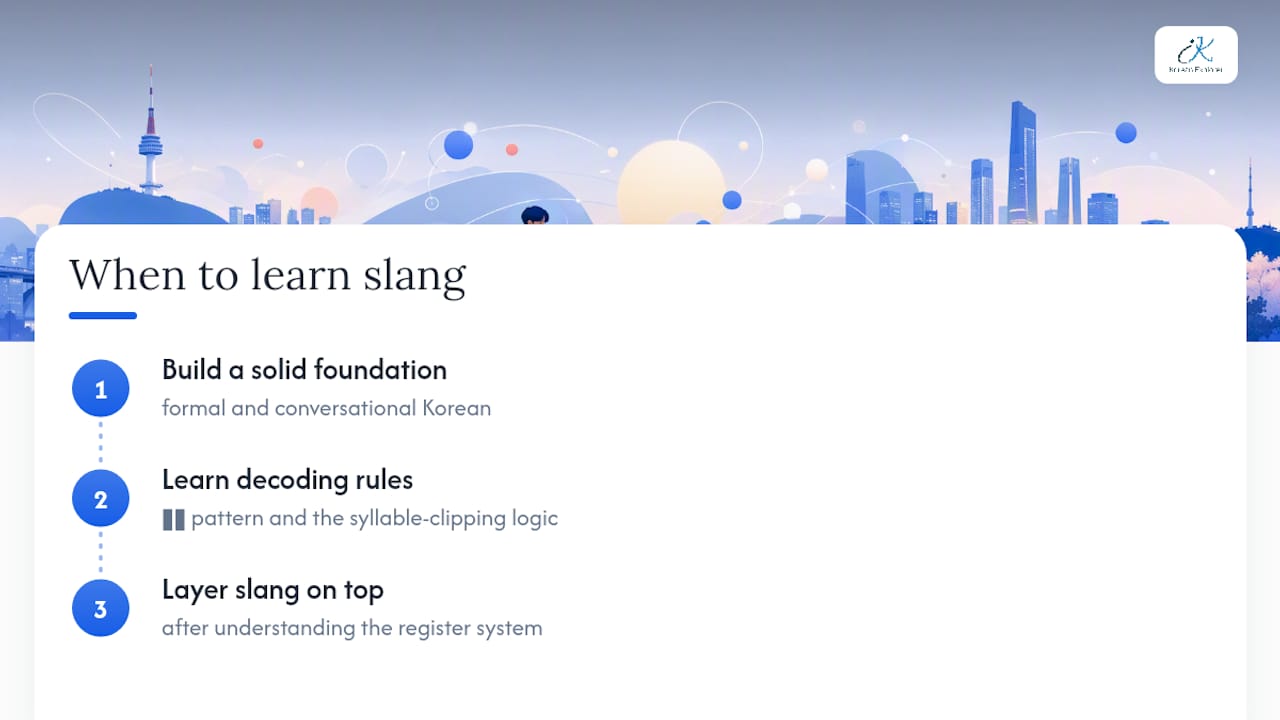
That said, the learners who use slang most naturally are the ones who learned it last, not first. They built a solid foundation in formal and conversational Korean, then layered slang on top once they understood the register system well enough to know when to switch. Rushing slang before you understand formality is like learning to whisper before you can speak. The shorthand makes sense only when you already know what it is shortening.
The good news: the decoding rules are simple. Once you understand the 초성 pattern and the syllable-clipping logic, you can read most new slang without memorizing it. That is a skill worth building early, even if you hold off on using the terms yourself.
Korean Explorer helps you practice slang the right way
Reading about slang is useful. Practicing it with a native Korean speaker who can correct your register in real time is what actually makes it stick. Korean Explorer’s adult conversational courses are built around exactly this kind of interactive, context-aware practice: role-plays, real-life chat scenarios, and direct feedback from bilingual native instructors who understand both the Korean and the learner’s perspective.
Whether you prefer in-person classes at the Tanjong Pagar center or online Korean classes via Zoom, the format is flexible enough to fit around a working schedule. Group classes give you peer interaction to practice casual register; private lessons let you focus on exactly the gaps you want to close. If you are ready to move from reading slang to using it confidently, explore Korean Explorer’s adult courses and find the format that fits your schedule.
Sources
- Korean Internet Slang: Texting & Gen Z Terms You Need (2026)
- Elon
- Internet/Text Language | Korean Grammar Documentation | Practice Korean
- Korean Texting Slang Explained: ㅋㅋ, ㅠㅠ & 50+ Must-Know Codes (2026)
- 2026 Korean Texting Slang Guide: ㅋㅋ, ㅠㅠ, ㅇㅋ, ㄱㄱ, ㅈㅅ Explained | LoveKorea
- 50 Korean Text Slang Terms for the Modern Learner
- Abbreviation in Korean is 준말 jun-mal and 줄임말 ju-rim-mal | Busuu
FAQ
What does ㅋㅋ mean in Korean texting?
ㅋㅋ is the Korean equivalent of “lol” or “haha.” It is a casual laugh marker, and more ㅋ letters signal a harder laugh. A single ㅋ alone can read as sarcastic, so context matters.
What does ㄱㄱ mean in Korean chat?
ㄱㄱ is short for 고고 (go-go), meaning “let’s go” or “go ahead.” It signals enthusiasm or agreement to a plan and appears frequently in gaming chats and group planning messages.
What are some common Korean slang words for texting?
The most common include ㅋㅋ (haha), ㅠㅠ (crying/empathy), ㅇㅋ (OK), ㄱㅅ (thanks), ㅈㅅ (casual sorry), ㄴㄴ (nope), and ㄱㄱ (let’s go). All are casual and peer-only.
What does ~~~ mean in Korean texting?
A tilde string (~~~) in Korean chat is used to soften a tone or add a playful, drawn-out feeling to a sentence, similar to how English speakers might use “sooo” or trailing dots. It is not a standard abbreviation but a stylistic marker for friendliness or teasing.
Is Korean texting slang appropriate for all situations?
No. All Korean texting shorthand is casual register and belongs in peer-to-peer chats only. For messages to seniors, colleagues, or anyone you address formally, write full polite forms like 감사합니다 and 죄송합니다 instead.