Curriculum alignment is the intentional linking of learning goals, instruction, and assessment so that every lesson moves learners toward a clearly defined proficiency outcome. For adult Korean learners, that matters immediately: without it, you can spend months in class and still struggle to hold a real conversation, because the program never connected what it taught to what it actually measured. Standards like the ACTFL proficiency guidelines and performance checks such as the Oral Proficiency Interview (OPI) exist precisely to make that connection visible and verifiable.
Table of Contents
- What curriculum alignment actually connects
- How backwards design builds an aligned program
- Vertical vs. horizontal alignment in Korean programs
- How to spot a truly aligned program before you enroll
- A short aligned curriculum map: beginner to intermediate conversation
- Common mistakes programs make and how they hurt learners
- Questions to ask a Korean language school about alignment
- Key Takeaways
- Why alignment is the real differentiator for adult learners
- Useful sources
- FAQ
What curriculum alignment actually connects
A well-aligned curriculum links three elements into a coherent system: learning goals (competency descriptors), instructional activities (lessons, drills, conversation practice), and assessments (performance tasks, rubrics, speaking checks). When all three point at the same target, every class session has a purpose. When they don’t, learners repeat content they’ve already covered, skip skills they actually need, and receive grades that don’t reflect real communicative ability.
Assessment types that signal genuine alignment include performance tasks (a recorded role-play, a structured conversation on a set topic), rubric-scored speaking tests modeled on OPI-style criteria, and portfolio or recorded performance reviews. These are fundamentally different from grammar quizzes or fill-in-the-blank tests, which measure content recall rather than communicative competence.
Pro Tip: Before enrolling in any Korean program, ask for two things: the stated learning outcomes (written with action verbs like “can describe,” “can negotiate,” “can explain”) and at least one sample assessment with its rubric. If a school can’t produce both, the curriculum probably isn’t aligned.
How backwards design builds an aligned program
The most reliable way to achieve curriculum alignment is backwards design, a process developed by Grant Wiggins and Jay McTighe. It runs in three stages, and the order is what makes it work.
- Define the desired result. What should a learner be able to do at the end? For a conversational Korean course, this might be: “Can initiate and sustain a 5-minute conversation about daily routines and personal plans in informal Korean.”
- Determine acceptable evidence. What assessment proves the learner got there? A live role-play scored on a 4-point rubric covering fluency, vocabulary range, and grammatical accuracy.
- Plan learning experiences. Only now do you design lessons. Four lesson types that build toward that speaking outcome: script-based dialogue practice, vocabulary-in-context drills, unscripted pair conversations, and a recorded rehearsal with peer feedback.
Backwards design prevents the most common curriculum failure: teaching content in the order it appears in a textbook and then writing a test at the end to see what stuck. Assessment-first planning means every lesson has a defined role in producing the evidence of learning.
Vertical vs. horizontal alignment in Korean programs
Alignment has two dimensions, and both affect your experience as a learner.

| Dimension | What it means | What it looks like in a Korean program |
|---|---|---|
| Vertical alignment | Skills build logically across levels | Beginner covers Hangul, basic sentence patterns, and self-introduction; intermediate adds opinion expression, longer narratives, and formal/informal register shifts |
| Horizontal alignment | Consistent expectations across classes at the same level | Two different instructors teaching Beginner 2 use the same outcomes, rubrics, and placement criteria |
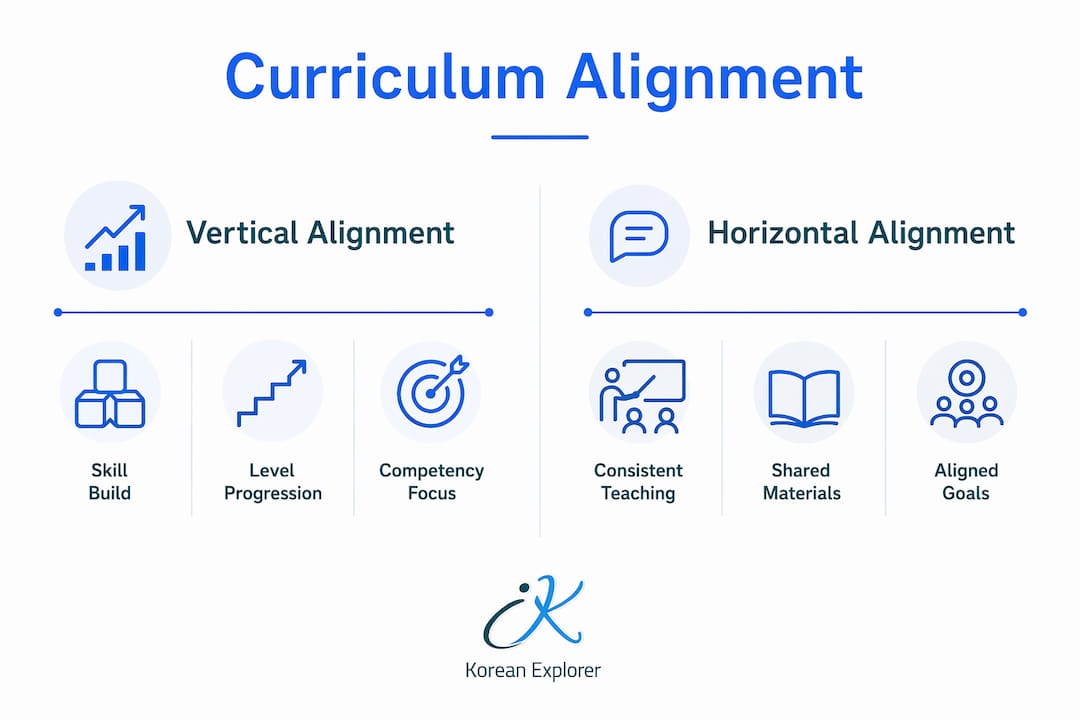
Vertical alignment is what makes level progression feel earned rather than arbitrary. Horizontal alignment is what makes it fair: if you switch instructors or class times, you shouldn’t land in a course that covers entirely different material or grades on a completely different scale. Both dimensions matter when you’re choosing between group and private class formats, since horizontal consistency is harder to maintain across large group cohorts.
How to spot a truly aligned program before you enroll
Use this checklist when evaluating any Korean language program.
Must verify:
- Published learning outcomes written with competency verbs (“can describe,” “can request,” “can explain a process”)
- At least one sample assessment with a scoring rubric
- Clear level descriptions showing what distinguishes Beginner 1 from Beginner 2 from Intermediate
- Evidence of practice-based assessment, not only written quizzes
Good to verify:
- A module sequence or curriculum map showing where each outcome is introduced, practiced, and assessed
- Instructor grading guidance or shared rubrics across the teaching team
- Estimated pacing (how many modules to reach conversational fluency)
Red flags to watch for:
- Detailed syllabus with no sample assessments or rubrics
- Outcomes written as topics (“we cover greetings, numbers, food vocabulary”) rather than competencies
- No stated criteria for level placement or advancement
- Inconsistent placement: different instructors put students at different levels based on informal judgment
Pro Tip: When you contact a school, ask: “Can you show me a sample speaking assessment and the rubric used to score it?” A confident, specific answer tells you more about alignment than any marketing description.
A short aligned curriculum map: beginner to intermediate conversation
This sample map shows what alignment looks like in practice across four modules of a conversational Korean pathway.
| Module | Learning outcome | Key lesson types | Sample assessment | Timing |
|---|---|---|---|---|
| 1 | Can read Hangul and introduce yourself | Script practice, pronunciation drills, Hangul writing | Recorded self-introduction (1 min, rubric: accuracy, clarity) | Introduction phase |
| 2 | Can describe daily routines using present tense | Vocabulary-in-context, dialogue modeling, pair practice | Live role-play: “describe your morning” scored on fluency and vocabulary | Practice phase |
| 3 | Can express preferences and make simple requests | Unscripted conversation tasks, formal/informal register contrast | Recorded conversation (2 min) scored on register accuracy and sentence variety | Development phase |
| 4 | Can narrate a past event and ask follow-up questions | Extended dialogue, peer feedback sessions, error correction | OPI-style speaking check: 5-min conversation with instructor, 4-point rubric | Synthesis/assessment phase |
Each assessment maps directly to the outcome for that module. No module ends with a grammar quiz alone. That’s the practical difference curriculum alignment makes visible.
Common mistakes programs make and how they hurt learners
Most misaligned Korean programs fail in predictable ways. Knowing them helps you spot the problem before you’ve paid for a full term.
- Content-first design: The course follows a textbook chapter by chapter, with no stated proficiency outcome driving the sequence. Learners cover a lot of vocabulary but can’t use it under real conversational pressure.
- Vague or missing outcomes: “Students will improve their Korean” is not a learning outcome. Without a measurable target, instruction and assessment drift in different directions.
- Assessment that doesn’t match instruction: A course built around conversation practice that tests learners only on written grammar. The skill practiced and the skill measured are different things.
- Inconsistent instructor expectations: One instructor marks a speaking task on fluency; another marks the same task on accuracy. Learners in the same level get different feedback and different grades for the same performance.
- Redundancy and gaps: Without a curriculum map, programs repeat content across levels and skip others entirely. Learners notice when they cover the same vocabulary set for the third time and still haven’t learned how to politely decline an invitation.
Questions to ask a Korean language school about alignment
Use these when you contact a school by email or phone.
Must ask:
- “What are the specific learning outcomes for this level, and how are they assessed?”
- “Can you share a sample assessment or rubric?”
- “How do you determine which level a new student should start at?”
Good to ask:
- “Do all instructors at this level use the same rubrics and grading criteria?”
- “Is there a curriculum map or module sequence I can review?”
- “How long does it typically take to move from beginner to intermediate conversation?”
Optional:
- “Are your outcomes aligned to any external proficiency standard, such as ACTFL?”
A brief email script: “I’m interested in enrolling in your conversational Korean course. Could you share the learning outcomes for the level you’d place me in, along with a sample speaking assessment and rubric? I want to understand how progress is measured before I commit.”
Pro Tip: A school that responds with specific documents rather than a general description of its teaching philosophy is showing you alignment in action.
Key Takeaways
A curriculum is only as strong as the connection between what it promises, what it teaches, and what it measures.
| Point | Details |
|---|---|
| Alignment definition | Curriculum alignment links learning goals, instruction, and assessment into one coherent system. |
| Strongest alignment signal | A program that provides stated competency outcomes and sample rubric-scored assessments before enrollment. |
| Backward design matters | Aligned programs define the final proficiency outcome first, then build assessments and lessons toward it. |
| Two dimensions to check | Vertical alignment builds skills across levels; horizontal alignment keeps expectations consistent across instructors. |
| Your next step | Ask any program for a sample speaking assessment and rubric before you enroll. |
Why alignment is the real differentiator for adult learners
Most adult learners who’ve spent time in a misaligned program describe the same experience: they finish a level, feel uncertain about what they actually learned, and struggle to place themselves on any meaningful scale. That’s not a motivation problem. It’s a design problem.
Alignment fixes it by making progress visible. When a program publishes competency descriptors, uses rubric-scored speaking tasks, and sequences instruction toward a defined outcome, learners know exactly where they stand and what they need to do next. The curriculum visibility research backs this up: when students can see how courses connect and where skills are taught and assessed, both learning and assessment outcomes improve.
What I’d look for in any Korean program: stated outcomes with action verbs, at least one sample speaking rubric, and evidence that instructors share grading criteria. Korean Explorer builds its courses on a Seoul National University curriculum with those signals built in, including native instructors, structured level progression, and both in-person and online options for adult learners. That’s the kind of structural transparency that makes a real difference over a 6-month or 12-month learning arc.
Useful sources
- ACTFL Proficiency Guidelines: The U.S. standard for defining language proficiency levels; use it to verify whether a program’s outcomes match recognized benchmarks.
- Curriculum Alignment and Mapping, University of Colorado Boulder: Practical overview of backwards design stages and curriculum mapping; useful for understanding what a well-structured program should produce.
- Guide to Unit Alignment, University of Sydney: Covers constructive alignment and how to check whether lessons actually produce the skills assessments measure.
- Improving Curriculum Alignment by Making the Curriculum Visible: University case study on how curriculum mapping tools improve student awareness and learning outcomes.
- Discovery Education: Curriculum Alignment Guide: Accessible overview of vertical and horizontal alignment with practical examples.
FAQ
What is curriculum alignment in simple terms?
Curriculum alignment means that a program’s learning goals, lessons, and assessments all point at the same outcome. Nothing is taught that isn’t assessed, and nothing is assessed that wasn’t taught.
How does curriculum alignment affect Korean language learning?
It determines whether your class time builds toward a measurable speaking or comprehension goal, or just covers content. Aligned programs use performance tasks and rubrics tied to proficiency standards like ACTFL, so progress is trackable.
What is backwards design in curriculum planning?
Backwards design starts with the final proficiency outcome, then defines the assessment that proves it, then builds lessons that produce that evidence. It’s the opposite of teaching chapter by chapter and testing at the end.
What’s the difference between vertical and horizontal alignment?
Vertical alignment means skills build logically from one level to the next. Horizontal alignment means all instructors at the same level use the same outcomes and rubrics, so your experience doesn’t depend on which class section you join.
What should I ask a Korean school to check for alignment?
Ask for the stated learning outcomes for your level and a sample speaking assessment with its rubric. If the school provides both, that’s a strong signal the curriculum is genuinely aligned.