TL;DR:
- Following TOPIK standards provides a government-backed, portable Korean proficiency credential trusted by institutions worldwide. It is designed and scored by South Korea’s National Institute for International Education, ensuring stability and comparability for admissions, employment, and visas.
Follow TOPIK standards because they give you a government-backed, portable proof of Korean ability that universities, employers, and immigration authorities rely on to make consistent decisions. The TOPIK certificate is valid for a limited period from the official result date, and it is administered by NIIED (National Institute for International Education), the South Korean government body that sets and maintains the exam. That combination of official governance and a fixed validity window is exactly why institutions trust it over self-reported proficiency.
Here is what a TOPIK score can unlock for you:
- University admission in South Korea, where most Korean-taught programs require Level 3 or 4
- Government scholarship eligibility, including routes that specify Level 3 or higher
- Employment at Korean companies or multinationals that use TOPIK as a hiring filter
- Visa points on residency scoring systems, where Levels 5–6 typically earn maximum language points
Before you register, confirm three things: which track you need (TOPIK I for Levels 1–2, or TOPIK II for Levels 3–6), the exact level your target institution requires, and whether your test date leaves the certificate valid at the application submission deadline.
Table of Contents
- What are TOPIK standards and who sets them?
- How do institutions actually use TOPIK scores?
- What are the direct benefits of aligning your study to TOPIK standards?
- What does each TOPIK level mean for your study focus?
- How do you align your study and preparation to TOPIK standards?
- Why do authorities and institutions trust TOPIK standards?
- What challenges do learners face when following TOPIK standards?
- How does TOPIK compare to other Korean proficiency frameworks?
- How have learners used TOPIK standards to reach real goals?
- How do TOPIK standards change, and how do you stay informed?
- Key Takeaways
- The case for TOPIK alignment is stronger than most learners realize
- Korean Explorer can help you prepare for TOPIK
- Useful sources
- FAQ
What are TOPIK standards and who sets them?
TOPIK, the Test of Proficiency in Korean, is the official international standard for measuring Korean language ability in non-native speakers. NIIED designs the exam, sets the scoring criteria, and publishes the official level descriptors that define what each score band means in practice.
The exam runs on two tracks. TOPIK I covers Levels 1–2 and tests only listening and reading, making it the right entry point for beginners. TOPIK II covers Levels 3–6 and adds a writing section, which is where productive skills get assessed. The jump from TOPIK I to TOPIK II is not just a harder test — it is a structural shift from receptive comprehension to demonstrated output.
Score bands are fixed: each level has a minimum score threshold within a 300-point scale for TOPIK II. The certificate carries the level number, not just a raw score, which is what institutions actually read.
Why government administration matters: When a credential is set and scored by a national government body rather than a private company, institutions in other countries can treat it as a neutral, comparable standard. NIIED’s role means the exam is not subject to commercial revision cycles or brand-specific scoring quirks — the descriptors stay stable enough for universities and immigration authorities to write them into formal policy.
TOPIK has been running since 1997. That track record, combined with NIIED’s oversight, is what pushed it from a useful language test into a formal administrative credential. For a deeper look at how TOPIK is structured, the full exam format breakdown is worth reading before you register.
How do institutions actually use TOPIK scores?
The short answer: they use TOPIK to filter applicants and award benefits without having to run their own language assessments. That saves institutions time and gives applicants a portable credential they can use across multiple programs.
| Use Case | Typical TOPIK Level Required |
|---|---|
| Korean-taught undergraduate admission | Level 3–4 |
| Korean-taught graduate programs | Level 4–5 |
| Government scholarship eligibility (e.g., GKS) | Level 3+ (varies by program) |
| Employment at Korean companies | Level 3–4 (professional roles often Level 5) |
| Points-based residency / visa scoring | Levels 5–6 for maximum language points |
These thresholds come from published institutional requirements and vary by program, department, and visa route. A graduate engineering program taught in Korean may require Level 4, while a business administration program at the same university might accept Level 3. Never assume a single threshold covers every path.
TOPIK I and TOPIK II matter here because some institutions specify the track, not just the level. A program requiring Level 3 means TOPIK II, since Level 3 only exists on that track. If your target requires Level 2, TOPIK I is sufficient. Always check whether the institution specifies the track or just the level number.
Pro Tip: Schedule your test so the result date falls at least two months before your application deadline. The certificate validity period is two years from the official result announcement, not the test date — and results typically release six to eight weeks after the exam. Missing that window means a retake.
For a full breakdown of how TOPIK scores map to certificates, the grading guide covers score bands and what each level certificate states.
What are the direct benefits of aligning your study to TOPIK standards?
The biggest practical benefit is that TOPIK replaces vague self-assessment with a number institutions can act on. “Intermediate Korean” means something different to every applicant. “TOPIK Level 4” means the same thing to every admissions officer, hiring manager, and visa officer who reads it.
Beyond the credential itself, aligning your study to TOPIK standards changes how you study, usually for the better:
- Measurable milestones replace open-ended progress. You know exactly what vocabulary range, grammar patterns, and task types each level requires.
- Faster institutional decisions follow from having a recognized level. Admissions offices do not need to evaluate your language separately when you hold a current certificate.
- Study efficiency improves because official level descriptors tell you which skills to prioritize. You stop spending time on content that does not move your score.
- Scholarship and placement eligibility often requires a specific level. Aligning study to TOPIK standards means you are building toward a threshold with real consequences, not just general fluency.
There is also a less obvious benefit: TOPIK preparation builds the kind of Korean that transfers to real professional and academic contexts. The writing tasks at Levels 4–6 require formal register, argumentation, and structured composition — exactly the skills a working professional or graduate student needs. Casual conversation practice alone does not get you there. For more on the benefits of taking the TOPIK test, that resource covers the credential’s practical payoff in detail.

What does each TOPIK level mean for your study focus?
| Level | Track | Skills Tested | Real-World Ability | Study Focus |
|---|---|---|---|---|
| 1 | TOPIK I | Listening, Reading | Basic survival communication | Core vocabulary, simple sentence patterns |
| 2 | TOPIK I | Listening, Reading | Everyday topics, simple tasks | Expanded vocabulary, common grammar structures |
| 3 | TOPIK II | Listening, Reading, Writing | Social topics, some formal contexts | Paragraph writing, intermediate grammar, topic vocabulary |
| 4 | TOPIK II | Listening, Reading, Writing | Professional and academic contexts | Formal writing, complex grammar, reading comprehension strategies |
| 5 | TOPIK II | Listening, Reading, Writing | Nuanced professional communication | Academic reading, argumentation, formal registers |
| 6 | TOPIK II | Listening, Reading, Writing | Near-native professional fluency | Advanced writing, academic discourse, precision listening |
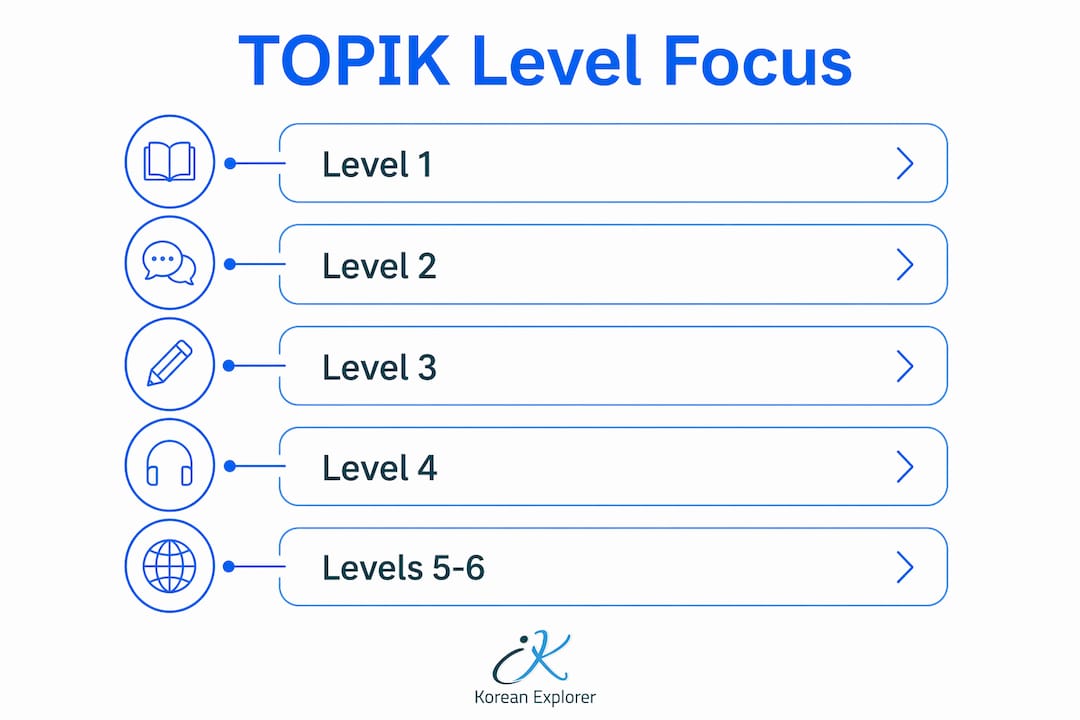
The structural shift at Level 3 is the one most learners underestimate. Moving from TOPIK I to TOPIK II is not just harder content — it introduces a writing section that requires you to produce Korean under timed conditions, not just recognize it. Learners who only practice receptive skills often stall at this transition.
At Levels 5–6, the exam tests whether you can handle academic and professional Korean with precision: formal registers, structured argumentation, and dense reading passages. These are the levels that unlock maximum visa points and open doors to senior professional roles. For a side-by-side look at TOPIK I vs TOPIK II, that comparison helps you choose the right track before you register.
How do you align your study and preparation to TOPIK standards?
Start by confirming the exact level and track your target institution or visa route requires. That single step prevents the most common mistake: preparing for the wrong level or the wrong track.
Sequential preparation steps:
- Take a diagnostic test to establish your current level. Official past papers work well for this.
- Read the official NIIED level descriptors for your target level. These tell you precisely what you need to demonstrate.
- Build a focused grammar list based on the patterns that appear at your target level. Do not study grammar above your target level until you have consolidated the current one.
- Practice timed past-paper sessions. Official past papers are published after each exam and simulate real test conditions accurately.
- For TOPIK II (Levels 3–6), build a writing feedback loop. Write practice essays weekly and get corrections from a qualified instructor or tutor.
- Run full mock exams under test conditions in the final four weeks before your exam date.
Sample timelines by goal:
- 3 months: Realistic for moving one level within the same track (e.g., Level 3 to Level 4) if you are studying 8–10 hours per week with structured support.
- 6 months: Suitable for crossing from TOPIK I to TOPIK II, or for learners starting from scratch aiming at Level 2.
- 12 months: Appropriate for reaching Level 5 from Level 3, especially when combining work or study with exam prep.
Always confirm institution-specific thresholds directly with the program or visa authority before finalizing your timeline. Requirements shift, and a single out-of-date source can send you to the wrong level. For practical preparation tactics, TOPIK preparation tips that actually move the needle covers the study strategies that produce the most consistent score gains.
Why do authorities and institutions trust TOPIK standards?
Scale and governance together. In 2023, over 550,000 people took the TOPIK exam across more than 90 countries. That volume means NIIED has extensive data to calibrate difficulty, maintain scoring consistency, and detect drift between exam sessions. No private language test at that scale operates under the same level of government accountability.
The policy signal: TOPIK’s acceptance into national education assessment pathways in countries like Vietnam shows that the credential has moved beyond individual learner use. When a government writes a foreign language test into its own national framework, it is treating that test as a reliable administrative tool, not just a study benchmark. That kind of policy-level recognition is what separates TOPIK from informal proficiency certificates.
The governance structure matters practically. Because NIIED sets the descriptors and the scoring, institutions do not need to independently verify what a Level 4 certificate means. The standard is published, stable, and backed by a government body. That reduces subjectivity in admissions and hiring in a way that self-reported proficiency or school-issued certificates cannot match.
For adult learners making significant decisions about study, careers, or residency, that institutional trust is the whole point. A TOPIK certificate travels with you across applications, employers, and borders in a way that a course completion letter does not.
What challenges do learners face when following TOPIK standards?
The writing section surprises most TOPIK II candidates. Listening and reading can be improved through input-heavy study, but writing requires deliberate production practice. Many learners spend months on grammar and vocabulary, then struggle with the 200-300 word essay tasks because they have never written Korean under time pressure. The fix is simple but requires discipline: write at least two timed practice essays per week from the first month of TOPIK II preparation.
Level confusion is common. Learners often target a level based on a general sense of their ability rather than a diagnostic test. The result is either under-preparation (aiming too low and passing easily, but not meeting the institutional threshold) or over-preparation (spending months on Level 5 content when Level 4 is all the program requires). A single past-paper diagnostic at the start saves weeks of misdirected study.
Certificate timing catches people off guard. The two-year validity window runs from the official result announcement date, not the test date. Results typically release weeks after the exam. If your application deadline is in March and you sit the exam in November, check the exact result release date before assuming the certificate will be valid in time.
Vocabulary gaps at higher levels. Levels 5 and 6 require academic and formal vocabulary that does not appear in everyday conversation. Learners who rely only on conversational practice hit a ceiling around Level 3–4. Supplementing with academic reading, news Korean, and formal writing samples is the standard fix.
How does TOPIK compare to other Korean proficiency frameworks?
TOPIK is the only Korean language proficiency test with full government backing from South Korea’s Ministry of Education through NIIED. That distinguishes it from school-issued certificates, private language school assessments, and informal proficiency ratings.
Some Korean language programs use internal placement tests or curriculum-aligned assessments. These are useful for class placement but carry no weight with universities, employers, or immigration authorities. They measure progress within a specific curriculum, not proficiency against a national standard.
The CEFR (Common European Framework of Reference) is the closest structural parallel. Like TOPIK, it uses a leveled scale and published descriptors. TOPIK levels roughly map to CEFR bands (Levels 1–2 approximate A1–A2; Levels 3–4 approximate B1–B2; Levels 5–6 approximate C1–C2), but the mapping is approximate and institutions that require TOPIK will not accept a CEFR-based Korean certificate as a substitute. For Korean-specific institutional requirements, TOPIK is the only credential that works.
Some universities in Korea also accept the KLAT (Korean Language Ability Test), but TOPIK remains the dominant standard for international applicants and is the one most visa and scholarship programs specify by name.
How have learners used TOPIK standards to reach real goals?
The most consistent pattern among adult learners who follow TOPIK standards is that having a concrete target level changes how they study, not just what they study. A learner preparing for Level 4 knows they need to produce coherent formal writing, handle professional listening passages, and read dense expository text. That specificity shapes daily study in a way that “get better at Korean” never does.
Adult professionals pursuing Korean company roles frequently cite TOPIK Level 4 or 5 as the threshold that opened doors that were previously closed to them, even when their spoken Korean was already functional. Employers use the certificate as a screening tool precisely because it is objective. A candidate who can hold a conversation but lacks a current TOPIK certificate often loses out to one with a Level 4, even if the conversational ability is comparable.
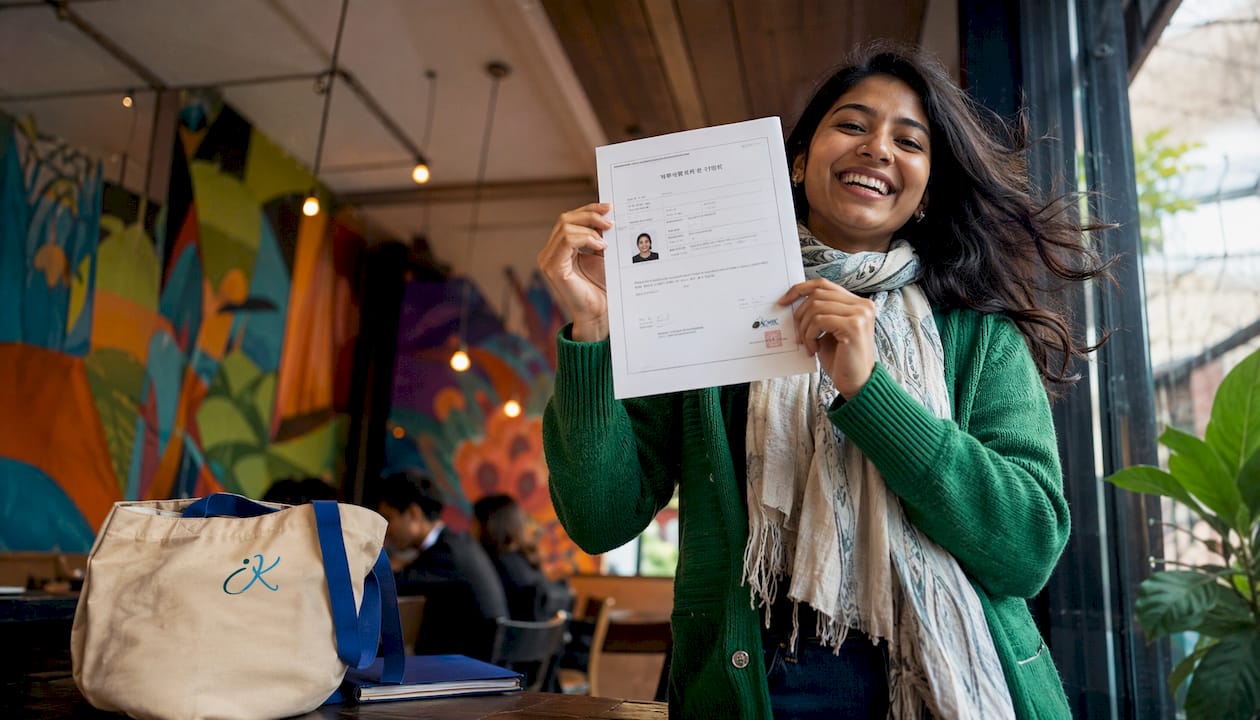
For learners targeting Korean university programs, the certificate serves a second function beyond admission: it determines class placement. Arriving with a Level 4 certificate means placement in an appropriate academic Korean course from day one, rather than repeating content you already know. That placement benefit alone saves a semester of time.
How do TOPIK standards change, and how do you stay informed?
NIIED reviews and updates the TOPIK format periodically. Past changes have included adjustments to the writing task format, score band thresholds, and the number of questions per section. These updates are announced on the official TOPIK website (topik.go.kr) and typically take effect from a specified exam session.
The most reliable way to stay current is to check the official NIIED announcements directly rather than relying on third-party guides, which may not reflect the most recent format. Before each exam registration window, review the current exam specifications on the official site.
For institutional requirements, the update cycle is separate. A university or visa program may change its TOPIK level threshold independently of any NIIED format change. Check the specific program’s admissions or requirements page each application cycle, not just once when you first research the program.
Subscribing to NIIED’s official communications and following the Korean Embassy or consulate in your country for visa-related TOPIK updates are the two most direct channels for staying informed.
Key Takeaways
Following TOPIK standards gives adult learners a government-backed, portable credential that universities, employers, and visa authorities use to make consistent decisions, with certificates valid for two years from the official result announcement date.
| Point | Details |
|---|---|
| NIIED administers TOPIK | The South Korean government body sets all level descriptors, scoring, and official requirements. |
| Certificate validity is two years | Schedule your exam so the result announcement falls within your application’s validity window, not just before the test date. |
| TOPIK I vs TOPIK II | TOPIK I covers Levels 1–2 (listening and reading only); TOPIK II covers Levels 3–6 and adds writing. |
| Institutional thresholds vary | Level 3–4 is common for university admission; Levels 5–6 earn maximum points on many visa routes. |
| Korean Explorer for structured prep | Korean Explorer’s adult courses align to TOPIK level descriptors with past-paper practice and writing feedback. |
The case for TOPIK alignment is stronger than most learners realize
Most learners treat TOPIK as a test they will eventually take, not as a framework that should shape how they study from day one. That is a costly delay. The official level descriptors are not just exam criteria — they are a map of what functional Korean actually looks like at each stage. Learners who ignore that map spend months on content that does not move their score or their real-world ability.
The two-year validity window is also underestimated. It is not a minor administrative detail. It means that if you pass Level 4 today and do not use the certificate for an application within two years from the official result announcement date, you are back to square one for any institution that requires current proof. Planning your exam timing around your application calendar is not optional — it is the difference between a certificate that works and one that expired before you needed it.
For adult learners with professional or academic goals, TOPIK alignment is the most direct route from where you are to where you need to be. The credential is portable, the standard is stable, and the institutional trust is already built in.
Korean Explorer can help you prepare for TOPIK
Structured preparation makes a measurable difference at every TOPIK level, and Korean Explorer’s adult courses are built around exactly that structure. Courses follow a curriculum developed by Seoul National University, mapped directly to TOPIK level descriptors, with timed past-paper practice, targeted writing feedback for TOPIK II candidates, and mock exams under real test conditions.
Whether you are starting from zero and targeting Level 2, or pushing from Level 3 toward the Level 5 threshold for a professional role, Korean Explorer offers group classes, private lessons, and online Korean classes via Zoom to fit around a working schedule. Corporate training is also available for teams preparing for Korean business contexts.
The next step is straightforward: browse the full range of Korean language courses and book a diagnostic consultation to confirm which level and track fits your goal.
Useful sources
- topik.go.kr — The official TOPIK site run by NIIED. Use this to verify current exam dates, registration windows, score bands, and certificate validity rules. The authoritative source for any format or policy update.
- NIIED official past papers — Published after each exam session. Use these for timed practice and to familiarize yourself with current question formats and difficulty calibration.
- TOPIK Complete Guide for Foreigners — TrulyKR — A practical overview of level thresholds and institutional uses, useful for cross-referencing typical requirements.
- TOPIK overview — topikguide.com — A well-organized reference for exam structure, scoring, and level descriptors.
- Your target institution’s admissions or requirements page — Always verify the specific TOPIK level and track required directly with the university, employer, or immigration authority. Third-party guides may not reflect the most recent requirements.
This article is general information for adult learners researching TOPIK standards. For visa, immigration, or scholarship eligibility, confirm current requirements directly with the relevant authority or a qualified advisor.
FAQ
What is the purpose of the TOPIK exam?
TOPIK measures Korean language proficiency in non-native speakers and provides a government-backed certificate that universities, employers, and immigration authorities use to make consistent decisions about admission, hiring, and visa eligibility.
What TOPIK level is considered fluent?
Levels 5 and 6 on TOPIK II represent near-native professional fluency, covering academic discourse, formal registers, and nuanced professional communication. Level 6 is the highest designation NIIED awards.
Is TOPIK required for Korean universities?
Most Korean-taught university programs require a TOPIK certificate, commonly Level 3 or 4 for undergraduate admission and Level 4 or 5 for graduate programs. Requirements vary by institution and department, so always confirm directly with your target program.
What is a good score on TOPIK?
“Good” depends on your goal. Level 4 is the threshold for most professional and academic purposes; Levels 5–6 unlock maximum language points on residency visa scoring systems and are expected for senior professional roles at Korean companies.
How long is a TOPIK certificate valid?
A TOPIK certificate is valid for two years from the official result announcement date. Plan your exam timing so the certificate remains valid at your application submission deadline, not just at the test date.