Run a 30-minute, theatre-informed Korean folktale session today. Pick one short tale, pre-teach three to five Korean words, layer in a call-and-response chant, add one movement element, and close with a single post-story activity. That is the whole method. Everything else in this guide builds on it.
Your session must-haves:
- Three to five target Korean words (nouns or verbs from the tale)
- One short folktale with a repeated motif (under 10 minutes to tell)
- Two drama elements: a chant and a physical action or gesture
- Simple props: picture cards, a puppet, or a scarf
- One assessment checkpoint: choral repetition or a quick role-play turn
Pick the 30-minute plan in Section 5, test it with a small group, then scale up.
Table of Contents
- Why Korean storytelling works for language and cultural learning
- Core interactive techniques that make sessions land
- How to choose and adapt Korean folktales by age and proficiency
- Ready-to-run session plans: 30, 45, and 60 minutes
- Practical activities, props, and assessment tools
- Cultural sensitivity and ethical adaptation when retelling folktales
- How adult educators can prepare: courses, workshops, and practice paths
- How to measure engagement and learning outcomes
- A model teaching approach: prepare, perform, extend
- Key Takeaways
- Why the “just tell the story” approach misses the point
- Useful sources for further study
- FAQ
Why Korean storytelling works for language and cultural learning
Interactive storytelling combines comprehensible input, spaced repetition, and embodied practice. That combination accelerates early vocabulary uptake in ways that reading alone cannot. When a child hears a word, sees it on a picture card, chants it, and then acts it out, the word sticks through multiple memory channels at once.
Festival programming backs this up. AFCC 2025 featured Dokkaebi’s Magic Club, an interactive session that taught a Dokkaebi dance and chant, dramatized scenes from Korean folklore, and wove simple Korean keywords into games for families. South Korea was the country of focus for AFCC 2025, which presented over 100 programmes combining literature, translation, and interactive storytelling. That scale of programming reflects genuine demand for culturally grounded, participatory Korean content.
Stat to know: Storytelling is an effective tool for building literacies in multilingual environments when practitioners combine translation, adaptation, and performative elements.
For adult educators, the payoff is practical: higher engagement from mixed-ability groups, richer cultural context than a textbook delivers, and scaffolding simple enough to run without specialist equipment.
Core interactive techniques that make sessions land
The best Korean storytelling sessions for children use a layered toolkit, not a single method. Here is what works:
- Call-and-response chants: Assign a repeated Korean phrase to a character or event. Every time the tiger appears, the group chants “호랑이! (Ho-rang-i!)” together.
- Simple choreography: Map a physical gesture to each target word. 달리다 (to run) gets a running-in-place action; 크다 (big) gets arms spread wide.
- Role-play and hot-seating: Pause the story and invite a child to speak as the character. One question, one answer, one Korean word used correctly.
- Props and puppetry: A tiger puppet or a moon-and-sun picture card gives children a concrete anchor for abstract vocabulary.
- Visual keyword cards: Display the three to five target words with an image. Point to the card each time the word appears in the story.
- Repetition cycles: Tell the same scene twice. The second time, pause before the key word and let children supply it.
To layer language scaffolds effectively, pre-teach the three target words before the story starts, model them in context during the telling, embed them in the chant, then allow child-led repetition in the post-story activity. That three-step cycle — model, embed, produce — is the core of the method.
Teaching Korean to young learners follows the same principle: repetition in context beats drilling in isolation.
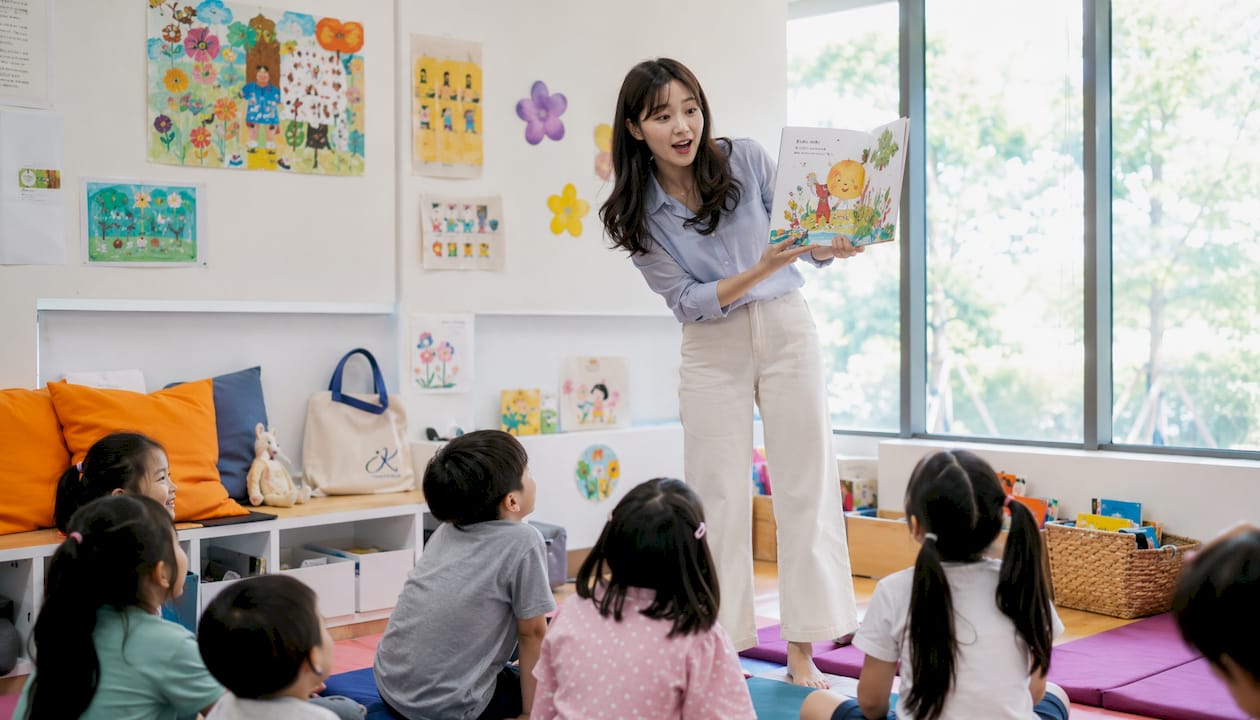
Pro Tip: Use interruptible dramatization. Stop mid-scene, look at the group, and ask: “What does the tiger say?” Pause long enough for a child to supply the Korean word or action. Inya Kang of Moodae emphasizes this kind of live participation as the mechanism that transmits Korean cultural feeling (jeong) across language barriers.
How to choose and adapt Korean folktales by age and proficiency
Short folktales with clear, repeated motifs and moral lessons work best. The Sun and the Moon, The Tiger and the Persimmon, and The Goblin’s Club are strong starting points because each has a recurring character, a predictable story beat, and a moral that translates cleanly across cultures. The Sejong Cultural Society publishes curated texts translated by Prof. Heinz Insu Fenkl, which are reliable for classroom use.
To adapt any tale: shorten scenes to two or three beats, simplify syntax to subject-verb-object, add a repeated line children can anticipate, and convert descriptive passages into physical actions.
| Age / Proficiency | Recommended Tale | Session Length | Example Target Words |
|---|---|---|---|
| Ages 4–6 / Beginner | The Sun and the Moon | 20–30 min | 해 (sun), 달 (moon), 크다 (big), 작다 (small) |
| Ages 7–9 / Early | The Tiger and the Persimmon | 30–45 min | 호랑이 (tiger), 무섭다 (scary), 먹다 (eat), 도망가다 (run away) |
| Ages 10+ / Developing | The Goblin’s Club | 45–60 min | 도깨비 (goblin), 마법 (magic), 싸우다 (fight), 이기다 (win), 착하다 (kind) |
Ready-to-run session plans: 30, 45, and 60 minutes
30-minute plan
Language objective: Introduce three nouns from the tale.
Materials: Picture cards (three words), one puppet or prop.
- (0–5 min) Pre-teach three words using picture cards. Choral repetition twice each.
- (5–15 min) Tell the folktale. Pause at each target word; point to the card.
- (15–22 min) Chant + action drill. Group chants the repeated line with gestures.
- (22–28 min) Quick role-play: two volunteers re-enact one scene using at least one target word.
- (28–30 min) Checkpoint: choral repetition of all three words from memory.
45-minute plan
Language objective: Introduce three verbs and two nouns; use them in a sentence.
Materials: Picture cards, whiteboard, simple puppets or scarves.
- (0–7 min) Pre-teach five words; write them on the whiteboard.
- (7–20 min) Tell the folktale with full dramatization. Invite choral responses at marked beats.
- (20–30 min) Chant + movement sequence. Group performs the scene with gestures.
- (30–40 min) Pair role-play: each pair re-enacts a scene and uses two target words.
- (40–45 min) Checkpoint: each pair says one sentence using a target word.
60-minute plan
Language objective: Introduce five words; produce a two-sentence retelling.
Materials: Picture cards, puppets, craft materials for a post-story activity.
- (0–10 min) Pre-teach five words with picture cards and a matching game.
- (10–25 min) Full dramatized storytelling with call-and-response chants.
- (25–40 min) Group role-play: assign character roles, re-enact two scenes.
- (40–52 min) Post-story activity: draw or craft one scene; label it with a target word.
- (52–60 min) Checkpoint: each child retells one moment using two sentences.
Assessment checkpoints for all plans:
- Choral repetition accuracy (can the group produce the word unprompted?)
- Single-turn role-play (does the child use the target word in context?)
- Post-story labeling or retelling (can they transfer the word to a new context?)
Practical activities, props, and assessment tools
Public storytelling events consistently pair performance with post-story activities. Istana Open House storytelling sessions, for example, close with craft segments that extend cultural engagement and consolidate vocabulary. The same principle applies to Korean folktale sessions.
Activity templates:
- Matching game (10 min, groups of 4): Match Korean word cards to picture cards. Works as a warm-up or cool-down.
- Chant + action (5 min, whole group): Perform the session chant with gestures. Repeat three times, increasing speed.
- Role-play prompts (15 min, pairs): Give each pair a one-line prompt in English; they respond using a target Korean word.
- Scene drawing + labeling (10 min, individual): Draw one scene from the tale; write the Korean word for one object or action.
Props and materials:
- Scarves (for movement and character differentiation)
- Laminated picture cards (one per target word)
- Simple hand puppets or paper-bag puppets
- Whiteboard or flip chart for live word display
Assessment tools:
- A two-item checklist: (1) Did the child use the target word? (2) Was the context correct?
- Peer feedback prompt: “Which Korean word did your partner use?”
- Evidence to collect: a short audio snippet of the role-play, or a photo of the labeled drawing.
Collaborative storytelling programmes that let children take the lead consistently show higher engagement and better retention than adult-directed sessions.
Cultural sensitivity and ethical adaptation when retelling folktales
Ethical adaptation keeps cultural markers intact while simplifying language. Stripping a Korean folktale down to a generic “good vs. evil” story loses the cultural specificity that makes it worth telling in the first place.
Preserve:
- Core motifs (the Dokkaebi’s club, the tiger’s fear of persimmons, the crane’s gratitude)
- Korean character names and honorifics used as meaningful tokens, not decoration
- The moral structure as the original culture frames it
Avoid:
- Flattening cultural practices into Western equivalents (a Dokkaebi is not just a “goblin”)
- Caricaturing characters for easy laughs at the expense of cultural nuance
- Presenting a single tale as representative of all Korean culture
Pro Tip: Add a bilingual note at the start of the session: one sentence in English explaining the cultural context of the tale, and the Korean name for the central character or concept. This preserves nuance without slowing the session. Always credit your source text — the Sejong Cultural Society translations by Prof. Heinz Insu Fenkl are a reliable, citable reference for U.S. and Singapore educators.
How adult educators can prepare: courses, workshops, and practice paths
Combine at least three sources of practice to build real competence: formal pedagogy training, theatre-based workshops, and micro-teaching practice with peer feedback. No single source is enough on its own.
What to look for in a professional development course:
- Theatre-informed pedagogy (not just language instruction theory)
- Demonstrable bilingual instruction by native speakers
- Observed practice hours with real learner groups
- Feedback mechanisms: rubric-based observation, not just self-assessment
Next-step action list:
- Audit your current skills: can you pre-teach three words, run a chant, and facilitate a role-play in one session?
- Attend a targeted workshop: look for storytelling events at festivals like 398.2 Storytelling Festival to observe professional tellers.
- Design a micro-teach: plan a 15-minute session, deliver it to two or three peers, record it, and review against the rubric in Section 9.
- Build your Korean language base: a structured course with native instructors gives you the linguistic confidence to model pronunciation accurately. Korean Explorer’s adult Korean courses offer group, private, and online formats taught by bilingual native instructors.
Learning Korean in Singapore through a structured program also gives educators the cultural fluency to adapt folktales responsibly, not just linguistically.
How to measure engagement and learning outcomes
Use a short formative rubric that measures three things: participation level, correct use of target words, and ability to re-enact a scene. That is enough data to iterate on session design without creating a marking burden.
Rubric template:
| Behavioral Marker | Not Yet | Emerging | Consistent |
|---|---|---|---|
| Joins chant unprompted | Rarely participates | Joins with prompting | Joins independently |
| Uses target word in context | Does not use target word | Uses word with support | Uses word independently |
| Re-enacts a scene element | Cannot recall scene | Re-enacts with prompting | Re-enacts independently |
Measurement tips:
- Audio-record one role-play turn per child (30 seconds is enough).
- Use the two-item checklist from Section 6 as your primary evidence.
- Write a one-line teacher reflection after each session: what worked, what to change.
One operational note: when recording children, obtain written parental permission before the session and store audio files securely per your institution’s data policy.
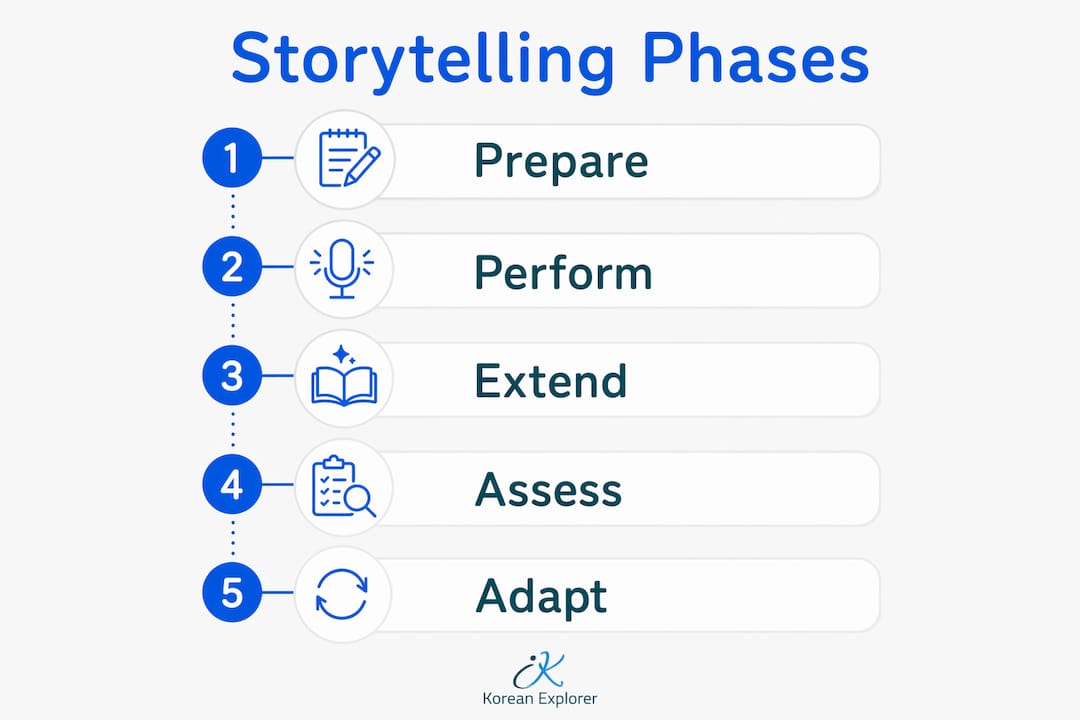
A model teaching approach: prepare, perform, extend
The most effective Korean storytelling sessions follow a three-phase structure drawn from practitioner experience and the programming model used at events like AFCC 2025.
Phase 1 — Prepare: Pre-teach three words, display them on cards, and run a quick chant to prime the group.
Phase 2 — Perform: Deliver the folktale with full theatre-informed dramatization. Pause for call-and-response. Invite children to supply words or actions at marked beats.
Phase 3 — Extend: Run a post-story activity (role-play, craft, or matching game) that requires children to use the target words in a new context. Close with the assessment checkpoint.
Kim Seung Ah, billed as Korea’s first professional storyteller, uses intimate folktale sessions to bring authentic performance to local audiences — a model worth observing before designing your own programme.
Korean Explorer’s curriculum, built on structured, conversation-focused instruction by native bilingual instructors, applies the same three-phase logic to adult language learning: introduce, practice in context, produce independently.
Key Takeaways
Theatre-informed Korean storytelling sessions work when they combine a tight word focus, embodied repetition, and a post-story activity that requires children to produce the language independently.
| Point | Details |
|---|---|
| Three-phase structure | Prepare (pre-teach words), Perform (dramatized telling), Extend (post-story activity). |
| Word focus | Limit each session to three to five target Korean words; embed them in a chant and a gesture. |
| Measure simply | Use a three-marker rubric: participation, correct word use, and scene re-enactment. |
| Cultural integrity | Preserve core motifs and Korean names; avoid flattening cultural specificity into generic equivalents. |
| Educator preparation | Combine pedagogy training, theatre workshops, and micro-teaching practice before leading sessions. |
Why the “just tell the story” approach misses the point
Most educators who try Korean storytelling for the first time treat it like a read-aloud with a Korean accent. They pick a tale, read it through, maybe hold up a picture, and wonder why engagement drops after three minutes. The story is not the lesson. The participation is.
What Inya Kang’s work with Moodae demonstrates, and what AFCC programming consistently reinforces, is that cultural transmission happens in the gaps: the pause before the chant, the moment a child supplies the word you left out, the gesture that maps a sound to a body memory. Those moments cannot be scripted, but they can be designed for. That is the whole point of the interruptible dramatization technique.
The other thing practitioners underestimate is the educator’s own language confidence. You do not need fluency to run a good session, but you do need accurate pronunciation of the five words you chose. One mispronounced target word, repeated six times in a chant, is six repetitions of the wrong model. That is worth fixing before the session, not after.
Useful sources for further study
- Dokkaebi’s Magic Club, AFCC 2025: The programme description for this interactive Korean storytelling session outlines the chant, dance, and keyword game structure — useful as a session design reference.
- Moodae (Inya Kang): Bilingual Korean theatre company whose work on participatory drama and jeong informs the core technique recommendations in this guide.
- Sejong Cultural Society — Korean Folk Tales: Ten curated folktale texts translated by Prof. Heinz Insu Fenkl; the most reliable free source for classroom-ready Korean tales.
- Kim Seung Ah at 398.2 Storytelling Festival: Professional Korean storytelling sessions in Singapore; attend to observe authentic delivery before designing your own programme.
- Evolve Arts: Theatre education organization running youth and family productions; useful for staging and workshop-production best practices.
- Korean Explorer — adult Korean courses: Structured, native-instructor-led courses for adult learners in Singapore; the right next step for educators who want to build their own Korean language base.
Recommended search terms for further research:
- “Korean folktale performance techniques for educators”
- “bilingual storytelling workshop Singapore”
- “jeong Korean cultural concept children’s literature”
- “AFCC South Korea programming 2025”
- “interactive drama language teaching early years”
FAQ
What Korean folktales work best for beginner sessions?
The Sun and the Moon and The Tiger and the Persimmon are the strongest starting points. Both have clear repeated motifs, simple moral structures, and vocabulary that maps easily to three to five target words.
How many Korean words should one session introduce?
Three to five words per session. More than five dilutes focus and reduces the number of meaningful repetitions each word receives.
Do educators need to speak Korean fluently to run these sessions?
No, but accurate pronunciation of the session’s target words is non-negotiable. A structured course with a native instructor is the fastest way to build that confidence before leading sessions.
Where can educators observe professional Korean storytelling in Singapore?
The 398.2 Storytelling Festival is a free, community-run event that features professional tellers; AFCC programming also regularly includes Korean-focused interactive sessions.
How do you assess whether children retained the target words?
Use a three-marker rubric: unprompted chant participation, correct word use in a role-play turn, and ability to re-enact one scene element. A short audio recording of the role-play is enough evidence for one session.