TL;DR:
- Watching K-dramas helps learners absorb social language and emotional context that textbooks lack. However, passive viewing alone does not develop structured grammar or speaking skills, making formal courses essential for comprehensive proficiency. Combining drama immersion with systematic study accelerates mastery of conversational and business Korean for adult learners.
If you love K-dramas and want to speak Korean for real, the most effective path combines drama immersion with structured formal study. Watching Crash Landing on You or Squid Game gives you emotional context, natural pronunciation, and social language cues you simply cannot get from a textbook. But passive watching alone won’t get you to conversational or business-level Korean. You need both.
Here’s what that combination actually looks like in practice:
- Immersive exposure: K-dramas teach formality levels, honorifics, and sentence-ending variations through real character interactions.
- Active techniques: Shadowing, vocabulary note-taking, and dialogue prediction turn watching into genuine practice.
- Technology support: Dual-subtitle browser extensions display Korean and English simultaneously, reinforcing Hangul recognition in real time.
- Formal coursework: Structured adult courses, like those at Korean Explorer Language School, build the grammar and syntax foundation dramas cannot provide.
- Business focus: For professional proficiency, targeted business Korean modules are non-negotiable alongside drama exposure.
Table of Contents
- Why K-dramas help you learn Korean (and where they fall short)
- How to turn K-drama watching into real Korean practice
- What structured Korean courses give you that dramas can’t
- Active learning techniques that deepen what dramas start
- Korean Explorer: structured courses built for adult learners
- Key Takeaways
- FAQ
Why K-dramas help you learn Korean (and where they fall short)
K-dramas work as language tools because emotion anchors memory. When a character delivers 미안해 (mianhae, “I’m sorry”) in tears, you don’t just note the word. You feel its weight. That emotional context is one of the strongest retention mechanisms in language acquisition.
Dramas also make Korean’s social hierarchy visible in a way no textbook can replicate. Formal speech (존댓말, jondaemal) appears in workplace scenes and interactions with elders; casual speech (반말, banmal) shows up between close friends and couples. You watch the same character shift registers depending on who walks into the room. That’s a live grammar lesson.
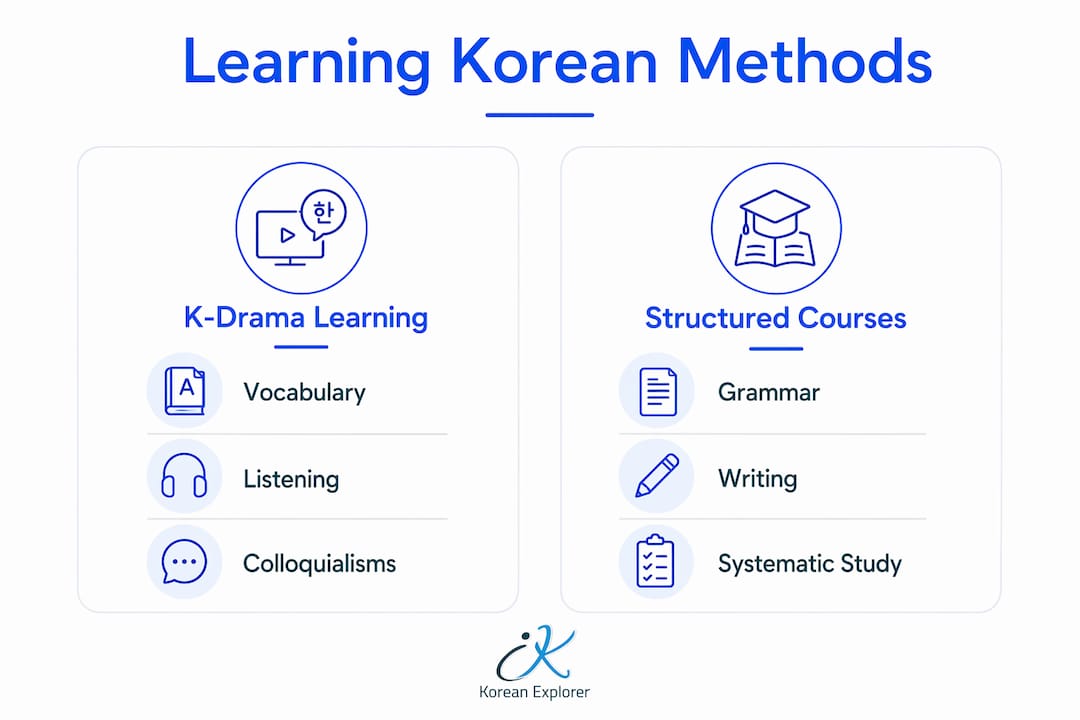
Slang and colloquial expressions are another area where dramas outperform textbooks. Words like daebak (awesome), chincha (really), and aigoo (an expression of exasperation) appear constantly in modern shows but rarely in formal learning materials. Hearing them in context, with the speaker’s age, relationship, and emotional tone visible, teaches you when they’re appropriate to use.
The catch is subtitle reliability. Research on Korean-English drama subtitles shows that the most frequent translation errors occur in josa (particles) and eomi (verb endings), the exact components that express tense and social relationships in Korean sentences. If you’re learning passively from English subtitles alone, you’re absorbing a filtered, sometimes inaccurate version of the language.
Pro Tip: When watching, pay specific attention to sentence endings. The difference between 해요, 해, and 합니다 isn’t cosmetic. It signals the entire social dynamic of the interaction. Train yourself to notice these endings before you look at the subtitle translation.
How to turn K-drama watching into real Korean practice
The gap between enjoying a drama and actually learning Korean from it comes down to method. Here’s what works:
- Use dual subtitles. Watching with Korean text on top and English below forces your brain to process audio, Hangul, and meaning simultaneously. This triple reinforcement builds connections that isolated vocabulary drills cannot.
- Apply the Triple-Watch method. First viewing: follow the plot and emotional context. Second viewing: switch to Korean subtitles and connect sounds to Hangul. Third viewing: no subtitles, short familiar scenes only. Each pass serves a different cognitive purpose.
- Shadow the dialogue. Replay a line and repeat it immediately, matching the actor’s rhythm, intonation, and emotional delivery. This trains your mouth and your ear at the same time.
- Use the 5-Phrase Rule. After each episode, identify five phrases that recurred or felt useful. Write them in Hangul with context notes. Reviewing ten to fifteen entries per session consolidates what you absorbed.
- Pause and predict. Before a character responds, try to guess their line in Korean. You’ll be wrong often. That’s the point. Your brain pays sharper attention when it’s comparing a prediction to reality.
- Start with slice-of-life dramas. Shows like Hometown Cha-Cha-Cha or My Mister give you everyday vocabulary in manageable pacing. Historical dramas packed with archaic speech are advanced material. Save them.
- Avoid purely passive watching. Watching with only English subtitles means your brain takes the easy route and ignores the Korean audio entirely. You can spend hundreds of hours this way and barely progress.
Pro Tip: Once dual subtitles feel comfortable, switch to Korean-only subtitles for scenes you’ve already watched once. Forcing your brain to connect sound and script without the English safety net accelerates Hangul mastery faster than any other single technique.
What structured Korean courses give you that dramas can’t
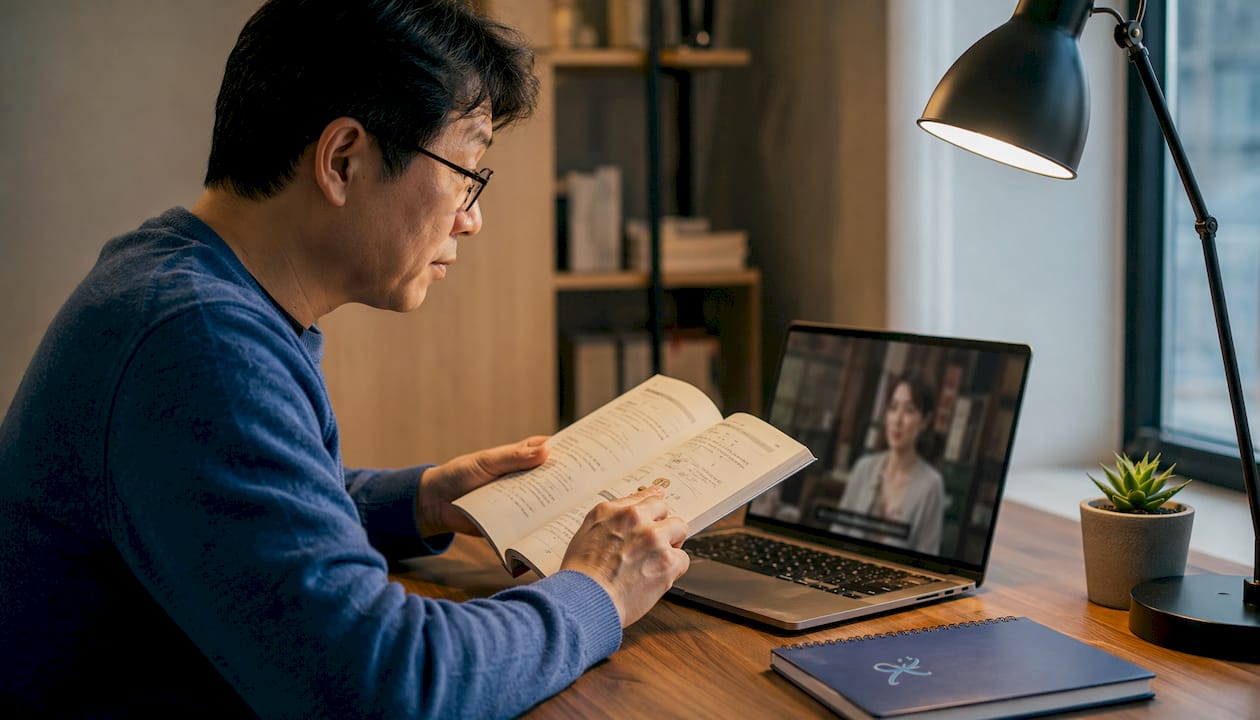
Drama immersion builds listening intuition and vocabulary exposure. It does not build systematic grammar, writing ability, or the kind of structured output required for business Korean. That’s where formal courses become necessary, not optional.
Korean Explorer Language School’s adult Korean courses are built on a curriculum developed by Seoul National University and aligned with internationally recognized proficiency standards. That foundation matters because it sequences grammar logically, something dramas never do. You might hear a complex conditional structure in episode three of a drama and have no framework to understand why it’s formed that way.
The school’s native Korean instructors are fluent in both Korean and English, which means they can explain why a sentence sounds wrong in Korean, not just that it does. Interactive, conversation-focused classes build the kind of real-time speaking confidence that drama watching alone cannot develop. You need to produce language under pressure, not just recognize it.
Flexible formats include group classes, private lessons, and online Zoom sessions, so adult learners with full schedules can fit structured study around work. For those targeting professional use, business Korean modules address workplace communication, formal correspondence, and meeting etiquette. Korean Explorer’s training center is located at 10 Anson Road, Level 22, International Plaza, Singapore 079903, directly above Tanjong Pagar MRT, with additional centers available for learners across the island.
Cultural understanding is woven into the coursework too. Knowing that 선배 (sunbae) and 후배 (hubae) reflect a hierarchical relationship, not just seniority, changes how you read every workplace drama scene and every real Korean professional interaction.
Active learning techniques that deepen what dramas start
Shadowing deserves more attention than most learners give it. The technique, repeating lines immediately after hearing them, internalizes Korean’s sentence rhythm and pitch movement without rote memorization. Korean has a musical quality where pitch changes affect meaning. Ten to fifteen minutes of shadowing per drama session produces faster pronunciation improvement than any textbook drill. The key is mimicking the actor’s emotional inflection, not just the words.
Beyond shadowing, a few other techniques make a measurable difference:
- Active note-taking on phrases, not isolated words. Korean is highly contextual. Learning 진짜요? (jinjjayo?, “Really?”) as a complete phrase in a specific social situation is more useful than memorizing vocabulary lists.
- Focus on functional sentence endings. Endings like 아/어요, 습니다, and 아/어 carry social information that changes the entire feel of an interaction. Dramas give you thousands of natural examples; your job is to notice them deliberately.
- Integrate honorific forms into practice. Terms like 언니, 오빠, and 아저씨 aren’t just vocabulary. They reflect relationships. Practicing them in context, through both drama exposure and structured resources, builds the social intuition that makes Korean feel natural.
- Combine passive exposure with active output. Watching builds comprehension. Speaking exercises, self-talk, and conversation practice build expressive ability. You need both sides to develop balanced proficiency.
For fans who also engage with K-pop and music video content, engaging with Korean video content across formats reinforces the same vocabulary and speech patterns from multiple angles, which accelerates retention.
Korean Explorer: structured courses built for adult learners
Korean Explorer Language School is the structured route for adults who want to move from K-drama fan to confident Korean speaker, in conversation and in the boardroom.
The school’s curriculum, developed by Seoul National University and aligned with internationally recognized proficiency standards, gives you the grammar scaffolding that drama immersion never provides. Experienced native instructors explain the why behind Korean sentence structure, not just the what. Classes are conversation-focused, so you practice producing language, not just recognizing it. Online Zoom options mean you can attend from anywhere without rearranging your schedule. Whether you’re targeting everyday fluency or professional Korean for corporate use, Korean Explorer has a course format that fits. Visit Korean Explorer’s language courses to find the right level and format for where you are now.
Key Takeaways
Combining K-drama immersion with structured formal study is the most effective way for adult learners to reach conversational and business Korean proficiency.
| Point | Details |
|---|---|
| Dramas teach social language | Formality levels, honorifics, and speech register shifts are best learned through drama context, not textbooks. |
| Subtitle errors are real | Korean-English subtitles frequently mistranslate josa and eomi, so passive subtitle reading can reinforce errors. |
| Shadowing accelerates pronunciation | Repeating lines immediately after actors internalizes Korean rhythm and intonation faster than drills. |
| Start with slice-of-life dramas | Everyday settings give beginners practical vocabulary; historical or technical genres add unnecessary complexity early on. |
| Korean Explorer fills the gaps | Structured adult courses built on Seoul National University curriculum provide the grammar foundation dramas cannot. |
FAQ
Can you really learn Korean just by watching K-dramas?
Dramas build listening comprehension, vocabulary, and pronunciation awareness, but they don’t develop systematic grammar or speaking ability on their own. Pairing drama exposure with formal coursework produces balanced, usable Korean.
What are the best K-dramas for Korean language basics?
Slice-of-life and romantic-comedy dramas like Crash Landing on You, My Mister, and Hometown Cha-Cha-Cha give beginners practical everyday vocabulary with manageable pacing and clear dialogue.
How does shadowing work for learning Korean?
Shadowing means repeating a character’s line immediately after hearing it, matching their rhythm, intonation, and emotional tone. It trains pronunciation and sentence structure simultaneously without rote memorization.
Why do Korean drama subtitles sometimes feel inaccurate?
Research on Korean-English drama subtitles shows that the most frequent translation errors occur in josa (particles) and eomi (verb endings), the exact components that express tense and social relationships in Korean sentences.
How does Korean Explorer support adult learners targeting business Korean?
Korean Explorer offers conversation-focused adult courses and business Korean modules, taught by native instructors, with flexible group, private, and online Zoom formats at its Singapore center above Tanjong Pagar MRT.